Ayahuasca Retreats for First-Timers: What to Really Expect

Affiliate Disclosure
We partner with retreat centers and booking platforms. When you book through our links, we may earn a commission at no extra cost to you. This supports our work and allows us to keep providing honest, in-depth reviews. Read our editorial policy
Table Of Content
- Affiliate Disclosure
- Introduction
- What Is Ayahuasca?
- Why People Seek Ayahuasca
- What Happens at an Ayahuasca Retreat
- The Ceremony: Hour by Hour
- The Purge: What First-Timers Need to Know
- Common First-Timer Experiences
- What First-Timers Fear (And the Reality)
- The Day After: What to Expect
- Multiple Ceremonies: How the Journey Unfolds
- Integration: The Real Work Begins
- Choosing the Right Retreat for First-Timers
- FAQ
- A Note on Respect
- Final Thoughts
The first ceremony brings a mix of anticipation and nerves. Everyone in that maloca felt the same way once.
Introduction
The candles flicker. The jungle hums outside. You’re sitting on a thin mattress in a circular wooden structure, surrounded by strangers who will soon become intimates in the most vulnerable experience of your lives. A small cup of dark, viscous liquid waits in the shaman’s hands. Your heart pounds. This is it.
If you’re considering ayahuasca retreats for first-timers, you probably have a thousand questions swirling through your mind. What does it actually feel like? Will I see visions? What if I have a bad trip? Will I vomit? What if I can’t handle it?
These questions are natural. Everyone who has ever drunk ayahuasca asked them too—including the shamans who now guide ceremonies.
This guide offers an honest, detailed account of what first-timers actually experience. Not the sanitized marketing version. Not the horror stories. The real, nuanced truth about what happens when you drink the vine of souls for the first time.
By the end, you’ll know exactly what to expect—and whether this profound, challenging, potentially life-changing experience is right for you.
What Is Ayahuasca?
Before diving into the experience, let’s understand what you’re working with.
The Basics
Ayahuasca is a psychoactive brew traditionally used by indigenous Amazonian peoples for healing, divination, and spiritual connection. The name comes from Quechua: aya (soul, ancestors) and wasca (vine)—”vine of the soul.”
The Brew
Ayahuasca combines two plants:
- Banisteriopsis caapi: The ayahuasca vine, containing MAOIs (monoamine oxidase inhibitors)
- Psychotria viridis (Chacruna) or Diplopterys cabrerana: Leaves containing DMT (dimethyltryptamine)
Neither plant is psychoactive alone. The vine’s MAOIs allow the DMT to become orally active—a discovery that indigenous peoples made thousands of years ago, somehow, in a jungle containing 80,000 plant species.
How It Works
DMT is one of the most powerful psychedelics known. Normally, your gut destroys it before it reaches your brain. The MAOIs in the vine prevent this destruction, allowing the DMT to cross the blood-brain barrier and produce its effects.
The result: a 4–6 hour journey into expanded consciousness, often described as the most profound experience of people’s lives.
Traditional Context
For indigenous peoples, ayahuasca isn’t a “drug” or even a “medicine” in the Western sense. It’s a plant teacher—a conscious, intelligent being that reveals truth, heals illness, and connects humans to the spirit world.
This perspective isn’t required to benefit from ayahuasca, but understanding it helps you approach the experience with appropriate respect.
Why People Seek Ayahuasca
First-timers come to ayahuasca for many reasons:
Healing
- Trauma (childhood, PTSD, grief)
- Depression and anxiety
- Addiction
- Chronic emotional pain
- Physical illness (some seek complementary healing)
Self-Understanding
- Breaking destructive patterns
- Understanding relationship dynamics
- Discovering purpose and direction
- Exploring the psyche
- Shadow work
Spiritual Seeking
- Direct experience of the divine
- Connection to something larger
- Answers to existential questions
- Spiritual awakening
- Exploring consciousness
Transformation
- Life transitions (divorce, career change, midlife)
- Feeling stuck or lost
- Seeking a reset
- Personal growth acceleration
What Ayahuasca Is NOT For
- Recreation or “getting high”
- Escaping problems without doing inner work
- Quick fixes without integration
- Proving something to yourself or others
- Curiosity without commitment
If your motivation is primarily curiosity or thrill-seeking, reconsider. Ayahuasca demands respect and intention.
What Happens at an Ayahuasca Retreat
Most retreats follow a similar structure, though details vary.
Arrival Day
You’ll arrive at the retreat center—often in a jungle setting, though urban and Western locations exist too. Expect:
- Welcome and orientation
- Meeting facilitators and other participants
- Tour of the space
- Review of rules and guidelines
- Light dinner (dieta-compliant)
- Early bedtime
Daily Structure (Non-Ceremony Days)
| Time | Activity |
|---|---|
| 6:00–7:00 AM | Wake up, light yoga or meditation |
| 7:30 AM | Breakfast (simple, clean) |
| 9:00–12:00 | Free time, nature walks, journaling, rest |
| 12:30 PM | Lunch |
| 2:00–5:00 PM | Integration circles, workshops, or free time |
| 6:00 PM | Light dinner |
| Evening | Rest, preparation for ceremony (on ceremony days) |
Ceremony Days
On ceremony days, the schedule shifts:
- Light breakfast
- No lunch or very light lunch
- Fasting from afternoon onward
- Rest and preparation
- Ceremony begins after dark (usually 8–9 PM)
- Ceremony lasts 4–6 hours
- Sleep afterward
- Late wake-up the next day
Number of Ceremonies
Most retreats include 2–4 ceremonies over 5–10 days. Multiple ceremonies allow:
- Deeper work (each ceremony builds on the last)
- Different experiences (no two ceremonies are alike)
- Time for integration between sessions
- Opportunity if first ceremony is challenging
The Ceremony: Hour by Hour
Here’s what a typical first ceremony looks like:
Before Ceremony (6–8 PM)
You’ve fasted since lunch. Nerves are building. You might:
- Shower and change into comfortable, light-colored clothes
- Set up your space (mattress, blanket, bucket, water, tissues)
- Sit quietly with your intentions
- Feel fear, excitement, anticipation—all normal
Opening (8–9 PM)
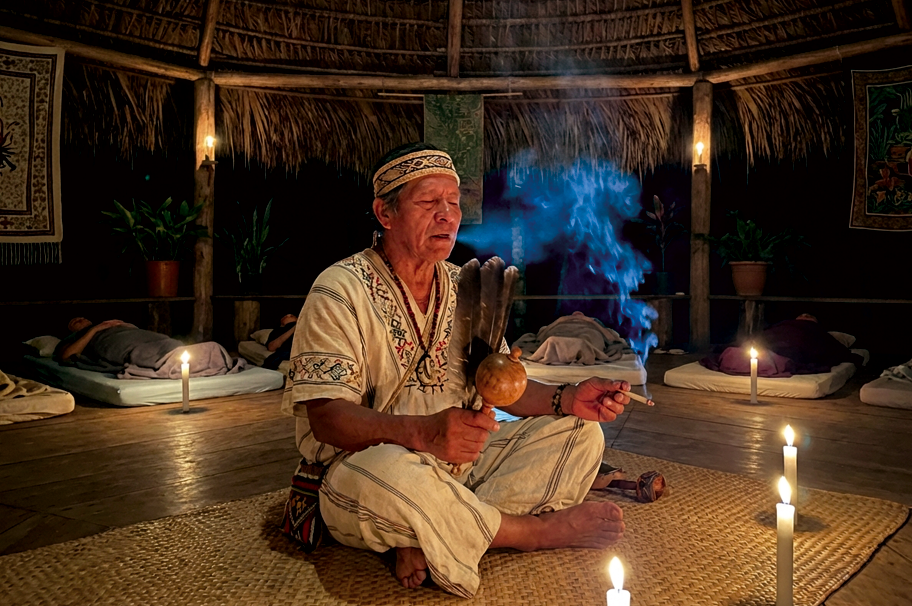
Participants gather in the ceremonial space (maloca). The facilitators:
- Open sacred space with prayer, song, or ritual
- Explain the ceremony structure
- Invite participants to share intentions (sometimes)
- Bless the medicine
The atmosphere is reverent. Candles flicker. The jungle sounds surround you.
Drinking (9 PM)
One by one, participants approach the shaman. You’ll receive a small cup—usually 30–60ml of thick, dark liquid.
The taste: Bitter. Earthy. Intense. Some describe it as drinking the forest floor. It’s not pleasant, but it’s manageable. You drink it down, return to your mattress, and wait.
The Come-Up (9:30–10:30 PM)
Effects typically begin 20–45 minutes after drinking. You might notice:
- Subtle shift in perception
- Slight nausea
- Tingling sensations
- Colors becoming more vivid
- Thoughts slowing or accelerating
- Yawning (very common)
The candles are extinguished. Darkness descends. The shaman begins singing icaros—sacred songs that guide the ceremony.
The Peak (10:30 PM–1 AM)
This is the heart of the experience. What happens varies enormously, but may include:
Visions:
- Geometric patterns (common early)
- Colors, fractals, sacred geometry
- Symbolic imagery (snakes, jaguars, plants)
- Scenes from your life
- Encounters with beings or entities
- Cosmic or mystical visions
- Some people see very little—this doesn’t mean it’s not working
Physical sensations:
- Nausea (very common)
- Purging—vomiting into your bucket
- Temperature fluctuations (hot/cold)
- Energy moving through body
- Heaviness or lightness
- Tingling, vibrating
Emotional experiences:
- Intense emotions surfacing
- Crying, laughing, shaking
- Revisiting memories
- Feeling overwhelming love
- Confronting fear or grief
- Profound peace
Cognitive shifts:
- Insights about your life
- Understanding patterns
- Seeing relationships clearly
- Receiving “downloads” of information
- Ego dissolution
- Sense of interconnection
The Icaros
Throughout ceremony, the shaman sings icaros—traditional healing songs. These aren’t background music. They:
- Guide the energy of the ceremony
- Direct the medicine’s work
- Provide an anchor during intensity
- Call in healing spirits (in traditional belief)
- Help participants navigate difficult passages
The icaros may sound strange at first—whistling, chanting, rhythmic melodies in indigenous languages. But many participants describe them as the most beautiful music they’ve ever heard.
Facilitator Support
If you’re struggling, facilitators are there to help. They may:
- Sit with you
- Sing to you directly
- Use mapacho (tobacco) smoke for clearing
- Offer words of reassurance
- Help you breathe through difficulty
You’re never alone, even in the darkest moments.
The Descent (1–3 AM)
Gradually, the intensity subsides. You might:
- Feel waves of peace
- Experience gentle visions
- Process what you’ve seen
- Rest in stillness
- Feel exhausted but clear
Closing (3–4 AM)
The shaman closes the ceremony with:
- Final songs
- Prayers of gratitude
- Closing of sacred space
- Sometimes, sharing circle
Candles are relit. You see the faces of your fellow travelers—transformed, tear-streaked, radiant, exhausted. A profound intimacy exists among people who’ve journeyed together.
After Ceremony
- Light snack may be offered (fruit, crackers)
- Return to your room
- Sleep (often deep and dreamful)
- Late wake-up the next day
The Purge: What First-Timers Need to Know
Let’s address the elephant in the room: vomiting.
Why It Happens
Ayahuasca commonly induces purging—vomiting, and sometimes diarrhea. This isn’t a side effect to be avoided. In traditional understanding, it’s a central part of the healing.
You’re not just purging physical contents. You’re releasing:
- Emotional blockages
- Energetic heaviness
- Trauma stored in the body
- What no longer serves you
What It’s Actually Like
Before: Nausea builds. You might resist, hoping it passes.
During: You lean over your bucket and release. It’s not pleasant, but it’s usually not as bad as feared. Many describe feeling immediate relief.
After: Often, a wave of clarity and lightness follows. The purge clears the way for deeper work.
Tips for First-Timers
- Don’t resist. Fighting nausea prolongs discomfort. When it’s time, let it happen.
- Have your bucket close. You won’t have much warning.
- Breathe. Deep breaths help move through nausea.
- Trust the process. The purge is healing, not punishment.
- You might not purge. Not everyone vomits every ceremony. Both experiences are valid.
Other Forms of Purging
Vomiting isn’t the only release. You might also experience:
- Crying (emotional purge)
- Yawning (energy release)
- Shaking or trembling
- Sweating
- Diarrhea (less common)
- Coughing
All are considered cleansing.
Common First-Timer Experiences
Every journey is unique, but certain experiences are common among first-timers:
“Nothing Is Happening”
Many first-timers spend the first hour thinking the medicine isn’t working. Then suddenly—it is. Be patient. The medicine operates on its own timeline.
Overwhelming Intensity
The opposite experience: feeling like it’s too much. The visions are too fast, the emotions too intense, the dissolution too complete.
What helps:
- Breathe slowly and deeply
- Remember: “This too shall pass”
- Surrender rather than fight
- Call for facilitator support
- Trust that you can handle this
Confronting Shadow
Ayahuasca often shows you what you’ve been avoiding—fears, shame, grief, anger. This can be terrifying but is usually deeply healing.
Encountering Entities
Many people report meeting beings—spirits, ancestors, plant intelligences, cosmic entities. Whether these are “real” or psychological projections is less important than the wisdom they offer.
Profound Love
Equally common: experiences of overwhelming love, connection, and unity. Feeling held by something vast and benevolent. Knowing, beyond doubt, that you are loved.
Confusion
Sometimes the experience is confusing rather than clear. Fragmented visions, unclear messages, disorientation. This is normal. Meaning often emerges later, during integration.
Physical Healing Sensations
Some people feel the medicine “working” on specific body areas—energy moving, blockages releasing, physical sensations of healing.
Nothing Visual, Everything Felt
Not everyone sees vivid visions. Some people’s journeys are primarily somatic (body-based) or emotional. This is equally valid and often equally profound.
What First-Timers Fear (And the Reality)
“What if I have a bad trip?”
Reality: Challenging experiences happen. But “bad trip” is a misnomer. Difficult passages often contain the deepest healing. With proper support, you can navigate intensity safely. Truly traumatic experiences are rare at reputable centers.
“What if I can’t handle it?”
Reality: You can handle more than you think. The medicine doesn’t give you more than you can process (though it may feel that way in the moment). Facilitators are there to help. And the intensity always passes.
“What if I go crazy?”
Reality: Temporary disorientation is common. Permanent psychological damage is extremely rare, especially at reputable centers with proper screening. If you have a history of psychosis or schizophrenia, ayahuasca is contraindicated—but for mentally healthy individuals, the risk is minimal.
“What if I die?”
Reality: The feeling of dying (ego death) is common and can be terrifying—but it’s not physical death. Actual medical emergencies are rare when proper screening and protocols are followed. You’re more likely to feel reborn than to be in danger.
“What if I vomit uncontrollably?”
Reality: Purging is usually a few intense moments, not hours of misery. Most people feel better after purging. And having a bucket right there means you’re prepared.
“What if I embarrass myself?”
Reality: Everyone in that maloca is going through their own intense experience. People cry, moan, laugh, vomit, shake. No one is judging. The vulnerability creates profound connection, not embarrassment.
“What if nothing happens?”
Reality: Sometimes first ceremonies are subtle. The medicine may be working on levels you can’t perceive. Trust the process. If you feel nothing, you may receive a second cup (offered at most ceremonies). And subsequent ceremonies often go deeper.
“What if I see something I can’t unsee?”
Reality: Ayahuasca can show you difficult truths—about yourself, your relationships, your life. This can be painful. But seeing truth, even painful truth, is the beginning of healing. What you “can’t unsee” is usually what you most needed to see.
The Day After: What to Expect
The morning after your first ceremony is unlike any other morning.
Physical State
- Exhausted: You’ve been through a lot. Rest is essential.
- Light: Many feel physically lighter, cleaner.
- Sensitive: Sounds, lights, and stimulation may feel intense.
- Hungry: After fasting and purging, gentle hunger returns.
Emotional State
- Raw: Emotions are close to the surface. Tears may come easily.
- Open: A sense of openness and vulnerability.
- Peaceful: Often, a profound calm beneath the rawness.
- Confused: Sometimes, uncertainty about what happened or what it means.
Mental State
- Reflective: The mind naturally processes the experience.
- Quiet: Mental chatter often reduced.
- Insightful: Realizations may continue emerging.
- Foggy: Sometimes, difficulty concentrating or articulating.
What to Do
- Rest. Don’t push yourself.
- Journal. Write while memories are fresh, even if it doesn’t make sense.
- Be in nature. Gentle walks help integration.
- Eat lightly. Simple, clean foods.
- Avoid screens. Give yourself space from stimulation.
- Connect gently. Sharing circles help process the experience.
- Don’t analyze too much. Let insights settle before dissecting them.
Multiple Ceremonies: How the Journey Unfolds
Most retreats include multiple ceremonies. Here’s how they typically progress:
First Ceremony: Introduction
The medicine introduces itself. You learn how ayahuasca works with your system. Often the most uncertain and anxious ceremony. May be gentle or intense—the medicine decides.
Second Ceremony: Deepening
With the first ceremony’s lessons integrated, you go deeper. Often more intense than the first. The medicine knows you now and can work more directly.
Third Ceremony: Integration
Themes from earlier ceremonies come together. Often the most profound insights. The medicine completes cycles of work begun earlier.
Fourth Ceremony (If Included): Completion
A sense of completion and gratitude. Often gentler. Receiving final teachings before returning to ordinary life.
Why Multiple Ceremonies Matter
- Each ceremony builds on the last
- Different aspects of healing emerge over time
- Integration between ceremonies deepens the work
- What’s confusing in one ceremony often clarifies in the next
- The relationship with the medicine develops
Integration: The Real Work Begins
The ceremony is just the beginning. Integration—applying what you learned to your life—is where transformation actually happens.
Immediate Integration (Days 1–7)
- Continue journaling daily
- Maintain clean diet
- Limit stimulation (screens, news, social media)
- Rest and allow processing
- Share with trusted people
- Don’t make major life decisions yet
Short-Term Integration (Weeks 2–8)
- Establish or deepen meditation practice
- Work with therapist or integration coach
- Make small changes aligned with insights
- Notice what’s different in your life
- Be patient with yourself
- Allow the experience to continue unfolding
Long-Term Integration (Months 2–12)
- Implement larger life changes gradually
- Maintain practices that support your growth
- Return to your notes and insights periodically
- Consider follow-up ceremonies when ready
- Stay connected to community
- Honor the medicine through how you live
Integration Practices
| Practice | How It Helps |
|---|---|
| Journaling | Processes insights, tracks changes, preserves memories |
| Meditation | Maintains connection to expanded states |
| Therapy | Professional support for processing difficult material |
| Bodywork | Releases stored trauma, integrates somatic experiences |
| Nature time | Grounds and connects to plant wisdom |
| Art/creativity | Expresses what words can’t capture |
| Community | Shared understanding, accountability, support |
The Integration Trap
Many first-timers expect the ceremony to “fix” them. They return home, do nothing different, and wonder why the transformation faded.
Ayahuasca shows you the path. You still have to walk it.
Choosing the Right Retreat for First-Timers
Not all retreats are suitable for beginners. Here’s what to look for:
Essential for First-Timers
- Thorough medical screening: They should ask detailed questions about medications, mental health, and physical conditions.
- Experienced facilitators: Look for years of experience and clear training lineage.
- Small group size: Ideally under 15 participants, with adequate facilitator ratio.
- Multiple ceremonies: 2–4 ceremonies allow deeper work than a single session.
- Integration support: Sharing circles, one-on-one check-ins, post-retreat resources.
- Clear safety protocols: What happens if someone has a medical or psychological emergency?
Red Flags for First-Timers
- No medical intake or screening
- Very large groups (20+ participants)
- Single facilitator for many people
- No integration support
- Mixing ayahuasca with other substances
- Pressure to drink more than comfortable
- Facilitators without clear lineage or training
- Sexual misconduct allegations
Questions to Ask
- What is your facilitators’ training and experience?
- How many participants per ceremony? How many facilitators?
- What medical conditions do you screen for?
- What happens if someone has a difficult experience?
- What integration support do you provide?
- Can I speak with past participants?
Location Considerations
Amazon jungle (Peru, Ecuador, Colombia):
- Most traditional setting
- Indigenous lineage
- Immersive but remote
- Variable comfort levels
Costa Rica:
- Legal gray area, many reputable centers
- More accessible than Amazon
- Often more comfortable facilities
- Strong integration focus
Europe (Netherlands, Portugal, Spain):
- Closer for European travelers
- Legal or tolerated in some countries
- Western-style support often available
- Less traditional setting
Domestic (where legal or decriminalized):
- No international travel required
- Familiar environment
- Varies widely in quality
FAQ
How do I know if I’m ready for ayahuasca? Readiness isn’t about having no fear—it’s about being willing despite the fear. If you feel called, have done your research, understand the commitment, and are in stable mental health, you’re likely ready. If you’re seeking escape rather than growth, wait.
What if the ayahuasca doesn’t work for me? Some first ceremonies are subtle. This doesn’t mean it’s not working—the medicine may be operating on levels you can’t perceive. Subsequent ceremonies often go deeper. Trust the process.
How many ceremonies should I do for my first retreat? Most first-timers benefit from 3–4 ceremonies. This allows the medicine to introduce itself, deepen the work, and provide integration. Single ceremonies can be profound but often feel incomplete.
Will I remember what happened? Usually, yes—though some details may fade like dreams. Journaling immediately after helps preserve memories. Some experiences are beyond words but leave lasting impressions.
Can I do ayahuasca alone? Absolutely not. Ayahuasca requires experienced facilitation for safety. Solo use is dangerous and disrespectful to the tradition. Always work with qualified facilitators.
What if I’m on antidepressants? SSRIs, SNRIs, and MAOIs are strictly contraindicated with ayahuasca due to risk of serotonin syndrome. You must taper off under medical supervision with adequate washout time (2–6 weeks minimum). Never stop medications abruptly.
Is ayahuasca addictive? No. Ayahuasca is not physically addictive and doesn’t produce cravings. In fact, it’s being studied as a treatment for addiction. The experience is often so intense that people need time before wanting to repeat it.
How long do the effects last? The acute ceremony experience lasts 4–6 hours. Aftereffects (sensitivity, openness, processing) continue for days to weeks. Lasting changes from proper integration can be permanent.
A Note on Respect
Ayahuasca is not a product to consume. It’s a sacred medicine with thousands of years of indigenous tradition behind it.
As a first-timer, you’re a guest in this tradition. Approach with:
- Humility: You don’t know what you don’t know.
- Respect: For the medicine, the tradition, the facilitators, and fellow participants.
- Gratitude: For indigenous peoples who preserved this knowledge.
- Reciprocity: Consider how you can give back, not just take.
The attitude you bring shapes what you receive.
Final Thoughts
Your first ayahuasca ceremony will likely be one of the most significant experiences of your life. It may also be one of the most challenging.
You’ll face yourself—your fears, your shadows, your deepest truths. You’ll purge what no longer serves you. You’ll receive teachings that words can’t capture. You’ll be broken open and put back together differently.
This isn’t a casual undertaking. It’s a commitment to your own healing and growth.
If you feel the call, honor it. Prepare thoroughly. Choose your retreat carefully. Surrender to the process.
The medicine has been waiting for you.
Ready to answer the call?
Your first ayahuasca retreat could be the beginning of profound transformation. Proper preparation, the right center, and an open heart create the conditions for deep healing. The jungle is waiting.