What to Expect at Your First Shamanic Retreat

Affiliate Disclosure
We partner with retreat centers and booking platforms. When you book through our links, we may earn a commission at no extra cost to you. This supports our work and allows us to keep providing honest, in-depth reviews. Read our editorial policy
Table Of Content
- Affiliate Disclosure
- Introduction
- What Is Shamanism?
- Types of Shamanic Retreats
- Common Ceremonies at Shamanic Retreats
- What Happens at a Shamanic Retreat
- Preparing for Your First Shamanic Retreat
- During the Retreat: Navigating Your Experience
- After Your Shamanic Retreat: Integration
- Safety and Discernment
- Types of Shamanic Retreats for Beginners
- FAQ: Your First Shamanic Retreat
- Final Thoughts)
Introduction
For tens of thousands of years, across every continent and culture, humans have turned to shamanic practices for healing, guidance, and connection to the sacred. From Siberian steppes to Amazonian jungles, from Celtic forests to African savannas, shamanism represents humanity’s oldest spiritual technology.
Now, you’re considering stepping into this ancient stream yourself. Your first shamanic retreat is approaching—and with it, questions. What actually happens at a first shamanic retreat? Is it safe? Will you have visions? What should you expect?
These questions honor the gravity of what you’re approaching. Shamanic work isn’t casual self-improvement. It’s an encounter with mystery, with the unseen dimensions of reality, with parts of yourself you may not know exist. It deserves respect—and preparation.
This guide walks you through everything you need to know about your first shamanic retreat. We’ll explore what shamanism actually is, the types of ceremonies you may encounter, what happens during and after, how to prepare, and how to integrate your experience. We’ll also address safety considerations and help you discern authentic practices from appropriation.
The spirits, the ancestors, the medicine—whatever language resonates—have been waiting. Let’s prepare you to meet them.
What Is Shamanism?
Before your first shamanic retreat, understand what you’re entering.
Shamanism Defined
Shamanism is not a religion but a collection of practices and worldviews found across human cultures. At its core, shamanism involves:
- Altered states of consciousness for healing and insight
- Communication with spirits (nature spirits, ancestors, guides)
- Energy work to restore balance and remove blockages
- Ceremony and ritual as containers for transformation
- Connection to nature as sacred and alive
The word “shaman” comes from the Tungus people of Siberia, meaning “one who sees in the dark” or “one who knows.”
Core Shamanic Beliefs
| Belief | What It Means |
|---|---|
| Everything is alive | Nature, objects, and places have spirit |
| Worlds exist beyond the visible | Upper, middle, and lower worlds |
| Illness has spiritual roots | Physical symptoms often have energetic causes |
| Healing requires restoring balance | Between self, community, nature, and spirit |
| Ancestors and guides are accessible | Through ceremony, we can communicate |
| The shaman mediates | Between ordinary and non-ordinary reality |
Shamanism Today
Modern shamanic retreats draw from various traditions:
- Indigenous traditions (with proper lineage and permission)
- Core shamanism (Michael Harner’s cross-cultural synthesis)
- Neo-shamanism (contemporary Western adaptations)
- Specific lineages (Peruvian, Mexican, Siberian, Celtic, etc.)
Types of Shamanic Retreats
Your first shamanic retreat could take many forms. Here’s an overview:
By Tradition
| Tradition | Origin | Key Practices | Plant Medicine |
|---|---|---|---|
| Amazonian/Peruvian | South America | Ayahuasca, plant dietas, icaros | Yes (ayahuasca, San Pedro) |
| Mexican/Mesoamerican | Mexico, Central America | Temazcal, psilocybin, Mazatec traditions | Yes (mushrooms, peyote) |
| Andean | Peru, Bolivia | Coca, despacho ceremonies, Q’ero traditions | Mild (coca leaf) |
| North American | Various tribes | Sweat lodge, vision quest, pipe ceremony | Varies by tradition |
| Siberian | Russia, Mongolia | Drumming, ancestor work, nature spirits | Sometimes |
| Celtic/European | Ireland, Britain, Scandinavia | Drum journeys, land spirits, seasonal rites | Rarely |
| African | Various traditions | Ancestor communication, divination, dance | Varies (iboga in some) |
| Core Shamanism | Cross-cultural | Drumming journeys, power animal retrieval | No |
By Intensity
Gentle Introduction (Best for Most First-Timers):
- Drum journey retreats
- Nature-based shamanic work
- Sweat lodge ceremonies
- Core shamanism workshops
- No plant medicine
Moderate Intensity:
- Multi-day ceremony retreats
- Vision quests (supported)
- Shamanic healing intensives
- Mild plant medicine (cacao, rapé, sananga)
High Intensity:
- Ayahuasca retreats
- Psilocybin ceremonies
- Iboga retreats
- Extended dietas
- Traditional vision quests
By Focus
| Focus | What to Expect | Best For |
|---|---|---|
| Healing | Extraction, soul retrieval, energy clearing | Processing trauma, illness, stuck patterns |
| Vision/Guidance | Journeying, divination, spirit communication | Life direction, decisions, clarity |
| Initiation | Rites of passage, death/rebirth experiences | Major transitions, spiritual calling |
| Connection | Nature communion, ancestor work, gratitude | Feeling disconnected, seeking belonging |
| Training | Learning shamanic skills | Those called to practice |
Common Ceremonies at Shamanic Retreats
Here’s what you might encounter at your first shamanic retreat.
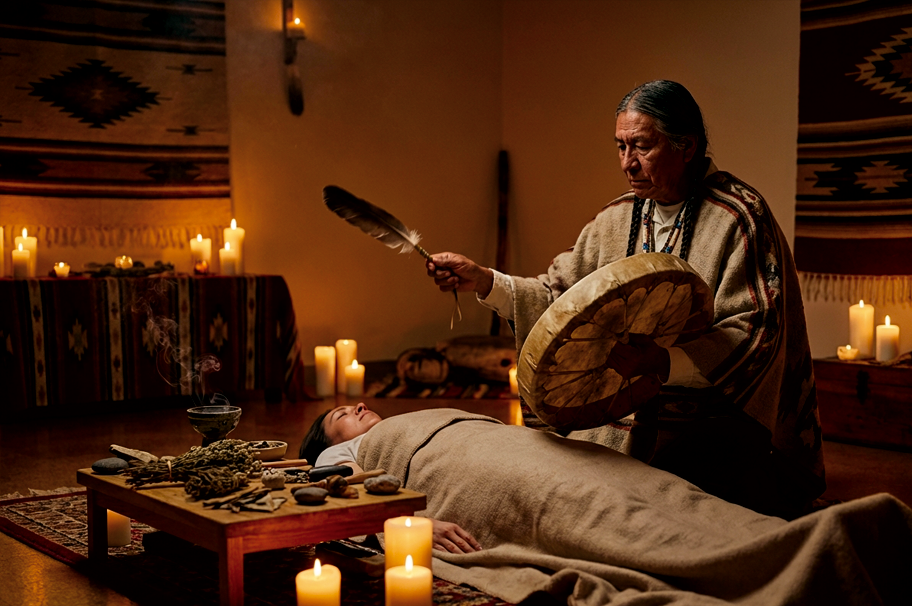
Drum Journeying
What it is: Using rhythmic drumming (typically 4-7 beats per second) to enter an altered state and “journey” to non-ordinary reality.
What happens:
- You lie down with eyes covered
- Steady drumming begins (live or recorded)
- You set an intention or question
- You follow inner imagery and experiences
- Drumming changes to signal return
- You share or journal your experience
What you might experience:
- Vivid imagery and landscapes
- Meeting power animals or guides
- Receiving messages or insights
- Emotional release
- Deep relaxation
- Sense of traveling to other realms
Intensity: Low to moderate Plant medicine: No
Sweat Lodge (Temazcal/Inipi)
What it is: Ceremonial sauna in a dome-shaped structure, representing return to the womb of Mother Earth.
What happens:
- Enter a small, dark, enclosed structure
- Heated stones (“grandmothers/grandfathers”) are brought in
- Water is poured on stones, creating intense steam
- Prayers, songs, and intentions are shared
- Multiple “rounds” of increasing intensity
- Emerge reborn, often into cold water
What you might experience:
- Intense heat and sweating
- Purification and release
- Altered states from heat
- Emotional catharsis
- Visions or insights
- Profound sense of rebirth
Intensity: Moderate to high (physically demanding) Plant medicine: No
Fire Ceremony
What it is: Ritual use of sacred fire for release, prayer, and transformation.
What happens:
- Gather around ceremonial fire
- Opening prayers and invocations
- Offerings to the fire (often symbolic items representing what you’re releasing)
- Songs, prayers, or silence
- Receiving warmth and light of the fire
- Closing prayers
What you might experience:
- Deep release as offerings burn
- Sense of purification
- Connection to ancient practice
- Meditation and trance states
- Community bonding
- Insights while gazing at flames
Intensity: Low to moderate Plant medicine: No
Soul Retrieval
What it is: Shamanic healing to recover soul parts lost through trauma, shock, or difficult experiences.
What happens:
- Shaman journeys on your behalf
- They search for lost soul parts
- They negotiate return of these parts
- Soul parts are blown back into your body
- Integration support provided
What you might experience:
- Feeling more whole or complete
- Return of lost vitality or qualities
- Memories or emotions surfacing
- Sense of something clicking into place
- Gradual integration over days/weeks
Intensity: Moderate Plant medicine: Usually no
Plant Medicine Ceremonies
What it is: Ceremonial use of psychoactive plants for healing and vision.
Common plant medicines:
| Medicine | Origin | Duration | Intensity | Legal Status |
|---|---|---|---|---|
| Ayahuasca | Amazon | 4-8 hours | Very high | Illegal most places; legal in some countries |
| Psilocybin mushrooms | Global | 4-6 hours | High | Decriminalized/legal in some places |
| San Pedro (Huachuma) | Andes | 8-14 hours | High | Legal in some countries |
| Peyote | Mexico/SW USA | 8-12 hours | High | Legal for NAC members; restricted otherwise |
| Iboga/Ibogaine | Africa | 24-36 hours | Very high | Legal in some countries |
| Cacao (ceremonial) | Mesoamerica | 2-4 hours | Low | Legal everywhere |
| Rapé/Sananga | Amazon | Minutes | Low-moderate | Legal most places |
Intensity: Varies (cacao is gentle; ayahuasca/iboga are intense) Note: Plant medicine retreats require additional preparation and screening
What Happens at a Shamanic Retreat
Here’s the typical flow of a first shamanic retreat.
Arrival and Opening
Day 1 typically includes:
- Welcome and settling into accommodation
- Introduction to the space and guidelines
- Meeting facilitators and other participants
- Opening circle with introductions and intentions
- Overview of the schedule and practices
- First gentle practice (often a drum journey or meditation)
- Dinner and early rest
The Ceremony Days
A typical ceremony day:
| Time | Activity |
|---|---|
| 6:00-7:00 AM | Optional morning practice (yoga, meditation, nature walk) |
| 7:30 AM | Breakfast (often light, sometimes specific diet) |
| 9:00 AM | Morning teaching or preparation |
| 10:30 AM | Morning ceremony or healing session |
| 1:00 PM | Lunch |
| 2:00-4:00 PM | Rest, integration, nature time |
| 4:30 PM | Afternoon sharing circle or teaching |
| 6:00 PM | Dinner (may be light before evening ceremony) |
| 8:00 PM | Evening ceremony (often the main ceremony) |
| Late | Rest when ceremony completes |
Closing and Departure
Final day typically includes:
- Integration session
- Sharing circle (experiences and insights)
- Teachings on continuing the work
- Closing ceremony
- Practical guidance for re-entry
- Departure
Preparing for Your First Shamanic Retreat
Proper preparation honors the work and enhances your first shamanic retreat.
Weeks Before
Physical preparation:
- Clean up your diet (reduce processed foods, alcohol, substances)
- Get adequate sleep
- Spend time in nature
- Begin slowing down and turning inward
- Follow any specific dietary guidelines (especially for plant medicine)
Mental/emotional preparation:
- Clarify your intention (what do you seek?)
- Journal about what you’re ready to release
- Journal about what you’re calling in
- Notice fears and resistance (normal)
- Begin dream journaling
Spiritual preparation:
- Spend time in prayer or meditation
- Connect with nature
- Honor your ancestors
- Create or tend an altar
- Ask for guidance and protection
Specific Dietas (Plant Medicine Retreats)
If attending ayahuasca or other plant medicine ceremonies, expect:
| Avoid (1-2 weeks before) | Why |
|---|---|
| Alcohol | Interferes with medicine, stresses liver |
| Recreational drugs | Interactions, unclear energy |
| Certain medications (especially SSRIs, MAOIs) | Dangerous interactions |
| Pork and red meat | Traditional restriction, heavy to digest |
| Fermented foods | MAO interactions with ayahuasca |
| Aged cheeses | MAO interactions |
| Sexual activity | Conserves energy for ceremony |
| Excessive media/stimulation | Keeps mind clear |
Always follow the specific guidelines of your retreat center.
What to Bring
Essentials:
- Comfortable, modest clothing (layers, natural fibers preferred)
- Blanket and pillow for ceremonies
- Journal and pen
- Flashlight/headlamp
- Water bottle
- Toiletries (natural/unscented preferred)
- Any required medications (disclosed to facilitators)
- Meaningful sacred object (optional)
- Photos of ancestors (optional)
- Offerings for altar or fire (tobacco, flowers, etc.—ask what’s appropriate)
Leave behind:
- Excessive technology
- Tight schedules
- Expectations of specific outcomes
- Skepticism as armor (openness serves better)

During the Retreat: Navigating Your Experience
Guidance for moving through your first shamanic retreat.
Entering Ceremony
Before each ceremony:
- Set your intention clearly
- Release attachment to specific outcomes
- Ask for protection and guidance
- Trust the process and the facilitators
- Surrender to what wants to happen
Mindset:
- Approach with respect and humility
- You are a guest in sacred space
- The spirits/medicine/practice are the teachers
- Your job is to show up and receive
During Ceremony
What to do:
- Follow the facilitator’s guidance
- Stay present with whatever arises
- Breathe through difficult moments
- Let sounds, movements, or emotions come through
- Ask for help if needed
- Trust your inner wisdom
What NOT to do:
- Fight or resist what’s happening
- Analyze during the experience (stay in body, not head)
- Compare your experience to others
- Leave the ceremonial space without permission
- Touch others without consent
- Record or photograph ceremonies
Common Experiences
| Experience | What It Means | How to Navigate |
|---|---|---|
| Visions or imagery | Non-ordinary perception opening | Observe without grasping; let them teach |
| Meeting beings/spirits | Contact with guides, ancestors, or archetypes | Greet with respect; ask questions |
| Emotional release | Stored feelings moving through | Let it flow; sound helps release |
| Physical sensations | Energy moving, blocks clearing | Breathe into it; don’t resist |
| Purging (plant medicine) | Physical and energetic cleansing | Surrender to it; it’s healing |
| Fear or darkness | Shadow material surfacing | Breathe; remember you’re safe; ask for help |
| Bliss or ecstasy | Connection to source, heart opening | Receive it fully; let it anchor |
| Nothing happening | Resistance, or subtle work occurring | Stay present; trust the process |
| Confusion | Old frameworks dissolving | Normal; clarity comes later |
Working with Difficult Experiences
If things get intense:
- Breathe — Deep, slow breaths regulate your nervous system
- Ground — Feel your body on the earth; you are here, now
- Remember — This is temporary; you are safe; help is available
- Surrender — Stop fighting; let it move through
- Ask for help — Raise your hand or call a facilitator
- Pray — Call on whatever you believe in for support
The shamanic perspective on difficulty:
- Healing often requires facing what we’ve avoided
- Darkness encountered is darkness being released
- The medicine/spirits show us what needs attention
- Difficulty often precedes breakthrough
- You are never given more than you can handle
Between Ceremonies
How to spend integration time:
- Rest and sleep (essential)
- Journal while experiences are fresh
- Spend time in nature
- Sit in silence
- Gentle movement (walking, stretching)
- Avoid heavy conversation or processing
- Stay off devices
- Drink water, eat lightly
- Continue to listen inwardly
After Your Shamanic Retreat: Integration
What happens after your first shamanic retreat determines whether transformation lasts.
Why Integration Matters
The retreat opens doors; integration walks through them.
According to the Multidisciplinary Association for Psychedelic Studies (MAPS), integration is essential for translating peak experiences into lasting change. Without it:
- Insights fade
- Old patterns return
- Opened material doesn’t fully process
- Spiritual experiences become just memories
- The gift of the work is lost
The First Week
Critical period—protect it:
| Do | Don’t |
|---|---|
| Keep a very light schedule | Rush back to normal life |
| Continue journaling daily | Make major life decisions |
| Rest and sleep deeply | Use alcohol or substances |
| Spend time in nature | Overshare with everyone |
| Eat nourishing, simple food | Return to unhealthy patterns |
| Maintain practices from retreat | Drop everything you learned |
| Honor what you experienced | Dismiss or minimize it |
| Stay connected to retreat community | Isolate completely |
Common Post-Retreat Experiences
Normal experiences in days/weeks following:
- Continued processing — Dreams, emotions, insights continuing to surface
- Sensitivity — Feeling raw, open, more affected by environment
- Seeing differently — Ordinary life looks different; priorities shift
- Grief — For the retreat ending, or material that surfaced
- Disorientation — Not fitting back into old life smoothly
- Gratitude — Deep appreciation for life, nature, connection
- Calling — Sense of new direction or purpose
- Desire to return — Missing the ceremonial space
Ongoing Integration Practices
Daily practices:
- Morning meditation or prayer
- Journaling
- Time in nature
- Gratitude practice
- Honoring your altar
- Conscious eating
Weekly practices:
- Drum journeying (you can learn to do this yourself)
- Community connection
- Extended time in nature
- Review of retreat insights and intentions
As needed:
- Therapy or coaching for processing
- Bodywork for continued release
- Return to ceremony when called
- Connection with shamanic community
When to Seek Support
Reach out if:
- Difficult experiences persist beyond 2-3 weeks
- You feel destabilized or unable to function
- Frightening experiences continue
- You’re having thoughts of self-harm
- You feel possessed or not yourself
- Integration feels impossible alone
Resources:
- Retreat facilitators (most offer follow-up)
- Integration therapists (specializing in psychedelic/shamanic integration)
- Shamanic practitioners for continued healing
- Supportive community members
Safety and Discernment
Protect yourself when choosing your first shamanic retreat.
Choosing Authentic Practitioners
Signs of legitimate shamanic facilitators:
| Green Flags | Red Flags |
|---|---|
| Clear lineage or training path | Vague or self-proclaimed credentials |
| Years of experience and practice | Recently started offering ceremonies |
| Humility about their role | Grandiose claims or ego |
| Respect for traditions they draw from | Mixing traditions carelessly |
| Thorough screening of participants | Accepting anyone who pays |
| Clear safety protocols | No apparent safety measures |
| Reasonable pricing | Extremely high prices or pressure tactics |
| References and reviews available | No way to verify their work |
| Ongoing relationship with their teachers | Isolated, no community or oversight |
| Clear about what they do and don’t offer | Promises to heal everything |
Cultural Sensitivity and Appropriation
Important considerations:
Shamanism belongs to specific cultures. As interest grows, so does appropriation—taking practices out of context, without permission, often for profit.
Questions to consider:
- Does this practitioner have legitimate connection to the tradition they’re sharing?
- Are indigenous communities being honored and compensated?
- Is the practice being offered with cultural context and respect?
- Am I approaching this as a consumer or as a humble student?
Ethical engagement:
- Seek practitioners with genuine lineage or permission
- Learn about the cultures these practices come from
- Give back to indigenous communities when possible
- Approach with respect, not entitlement
- Recognize you’re a guest in these traditions
Safety Considerations for Plant Medicine
If your first shamanic retreat includes plant medicine:
Medical screening is essential:
- Heart conditions
- Liver or kidney problems
- Psychiatric conditions (bipolar, schizophrenia, psychosis history)
- Medications (especially SSRIs, MAOIs, lithium)
- Pregnancy
- Recent surgery
Environmental safety:
- Adequate facilitator-to-participant ratio
- Medical support available
- Safe, contained space
- Screening for contraindications
- No sexual contact between facilitators and participants
- Clear protocols for difficult experiences
Legal considerations:
- Many plant medicines are illegal in most countries
- Some retreats operate in legal gray areas
- Research the legal status where you’re going
- Understand the risks you’re taking
Types of Shamanic Retreats for Beginners
Recommendations for your first shamanic retreat.
Best Starting Points
For complete beginners, consider:
- Drum Journey Retreat
- No plant medicine
- Gentle introduction to non-ordinary states
- Learn techniques you can practice at home
- Low risk, high reward
- Widely available
- Nature-Based Shamanic Retreat
- Connection with land and elements
- Gentle ceremonies (fire, water, earth, air)
- Grounding and accessible
- Often includes basic journeying
- Core Shamanism Workshop
- Cross-cultural, accessible approach
- Learn foundational practices
- No plant medicine
- Good education component
- Can continue practicing independently
- Sweat Lodge Retreat
- Powerful but no altered substances
- Physical challenge with spiritual depth
- Ancient, respected practice
- Widely available
- Clear beginning and end
Building Your Path
A possible progression:
| Stage | Experience | Purpose |
|---|---|---|
| First | Drum journey or nature-based retreat | Learn basics, test resonance |
| Second | Deeper shamanic healing retreat | Receive healing, go deeper |
| Third | Plant medicine (if called) | Profound transformation |
| Ongoing | Regular practice and occasional retreats | Maintain connection, continue growth |
You don’t have to do plant medicine. Many people have profound shamanic experiences through drumming, sweat lodge, vision quest, and other non-medicine practices. Follow your own calling.
Learn more:
→ How to prepare for a healing retreat
→ Healing retreats for beginners
FAQ: Your First Shamanic Retreat
Do I need to believe in spirits for shamanic work to help me? No. You can approach shamanism as a psychological technology—a way of accessing your unconscious mind through imagery and altered states. Many people find healing and insight regardless of their beliefs about the literal reality of spirits. That said, staying open rather than rigidly skeptical serves the work better. Let your experience inform your beliefs rather than the other way around.
Is shamanic work safe? When practiced with qualified facilitators in appropriate settings, shamanic work is generally safe. Risks increase with plant medicine, inadequate facilitation, or pre-existing mental health conditions. Non-medicine shamanic practices (drumming, sweat lodge, fire ceremony) carry minimal risk for most people. Always disclose health conditions, choose reputable retreats, and trust your instincts about safety.
What if I don’t have any visions or experiences? This is common, especially the first time. The mind may be too active, analyzing instead of experiencing. Resistance may be present. Or subtle work may be happening beneath conscious awareness. Don’t judge your experience against others’ dramatic stories. Sometimes the most profound shifts are quiet. Trust that whatever happens (or doesn’t seem to happen) is part of your process.
Will I lose control during ceremony? You remain yourself throughout shamanic experiences. Even in deep altered states, a part of you observes and can make choices. You can always open your eyes, sit up, or ask for help. Plant medicines can feel overwhelming, but you don’t lose your fundamental self. Facilitators are present to support you if experiences become intense.
How do I know if a shamanic retreat is legitimate? Research the facilitators’ training and lineage. Read reviews from past participants. Ask questions about safety protocols and screening. Trust your gut—if something feels off, honor that. Legitimate practitioners welcome questions and are transparent about their background. Be cautious of those who claim special powers, charge exorbitant prices, or dismiss your concerns.
Can shamanic work help with trauma? Yes, many people find shamanic practices helpful for trauma. Soul retrieval specifically addresses soul loss from traumatic experiences. However, shamanic work is not a replacement for trauma therapy, especially for severe or complex trauma. The combination of shamanic healing and trauma-informed therapy can be powerful. If you have significant trauma, ensure your retreat has trauma-aware facilitators.
What’s the difference between shamanic healing and therapy? Therapy typically works through talking, understanding, and cognitive reframing. Shamanic healing works through ceremony, energy, altered states, and spiritual intervention. Therapy addresses the psychological level; shamanism addresses the spiritual/energetic level. They’re complementary rather than competing. Many people benefit from both—shamanic work for breakthrough experiences, therapy for ongoing integration and support.
How often should I attend shamanic retreats? There’s no formula. Some people attend one retreat and integrate for years. Others feel called to regular ceremonial work. Quality matters more than quantity—one well-integrated retreat is worth more than many unintegrated ones. Listen to your inner guidance. If you feel called to return, honor that. If you need time to integrate, honor that too.
Final Thoughts)
Your first shamanic retreat is an invitation to remember something ancient.
Long before therapy, before self-help books, before wellness apps, humans gathered around fires, drank sacred plants, drummed themselves into trance, and touched the mystery at the heart of existence. They knew that healing happens in community, in ceremony, in connection with forces greater than the individual self.
This wisdom hasn’t disappeared. It’s been waiting—in the drum’s heartbeat, in the fire’s dance, in the plant’s teaching, in the shaman’s song. And now it’s calling you.
What you’ll find at a shamanic retreat isn’t escape from reality but deeper entrance into it. Not answers handed to you but questions that transform you. Not a guru to follow but your own inner wisdom awakened.
The spirits don’t care about your resume or your doubts. They care about your sincerity, your willingness, your open heart. Come as you are—broken and whole, skeptical and curious, afraid and ready.
The fire is lit. The drum is sounding. The medicine is prepared. The ancestors are watching.
All that remains is for you to step into the circle.
Ready to answer the call?
We’ve curated authentic shamanic retreats worldwide—from gentle drum journeys to transformative plant medicine ceremonies.