What to Expect at a Buddhist Meditation Retreat: A Complete Guide
Affiliate Disclosure
We partner with retreat centers and booking platforms. When you book through our links, we may earn a commission at no extra cost to you. This supports our work and allows us to keep providing honest, in-depth reviews. Read our editorial policy
Table Of Content
- Affiliate Disclosure
- Introduction
- Understanding Buddhist Meditation Retreats
- Buddhist Traditions and Retreat Styles
- The Daily Schedule at a Buddhist Meditation Retreat
- Core Practices You’ll Learn
- The Noble Silence
- Accommodations and Daily Life
- Common Challenges and How to Work with Them
- Do You Need to Be Buddhist?
- Preparing for Your Buddhist Meditation Retreat
- After the Retreat: Integration
- FAQ: Buddhist Meditation Retreat
- Final Thoughts
Introduction
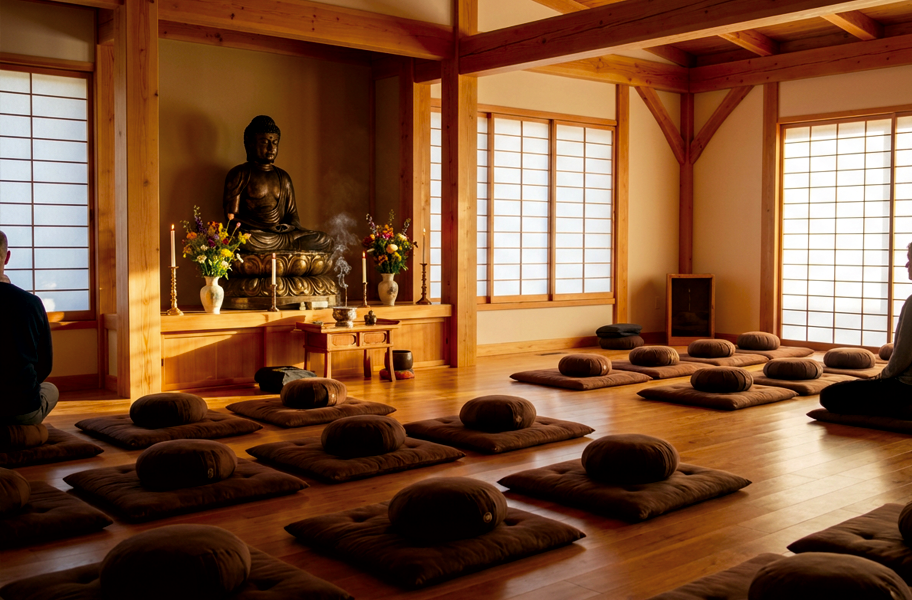
The bell rings through the pre-dawn darkness—a single, clear tone that seems to vibrate in your chest before fading into silence. Around you, others stir in their rooms. Footsteps pad softly down the hallway. The meditation hall awaits, cushions arranged in neat rows, a Buddha statue gazing serenely from the altar where incense smoke curls upward like a question mark dissolving into emptiness.
This is the world of a Buddhist meditation retreat—a world stripped of the usual distractions, where time moves differently and the ordinary activities of sitting, walking, and eating become doorways to awakening.
Perhaps you’ve been curious about Buddhist practice. Perhaps you’ve meditated with apps but sense there’s more depth available. Perhaps something in you is calling for silence, for simplicity, for the kind of transformation that only happens when you step out of your regular life and into a container designed for awakening.
But what actually happens at a Buddhist meditation retreat? What will you do all day? What are the rules? Will you have to become Buddhist? Will it be too hard? Too religious? Too boring?
This guide answers all of these questions. We’ll walk through every aspect of the Buddhist retreat experience—from the different traditions you might encounter to the daily schedule, from the practices you’ll learn to the challenges you’ll face. By the end, you’ll know exactly what awaits and how to prepare for it.
The path of meditation has been walked for 2,500 years. Countless practitioners have sat where you will sit, faced what you will face, and discovered what you might discover. You’re not pioneering unknown territory—you’re joining an ancient stream of seekers who found that the answer to suffering lies within.
Let’s explore what that journey looks like.
Understanding Buddhist Meditation Retreats
Before diving into specifics, let’s clarify what a Buddhist meditation retreat actually is and isn’t.
What Is a Buddhist Meditation Retreat?
A Buddhist meditation retreat is an extended period of intensive practice—typically ranging from a weekend to several months—held at a dedicated center or monastery. The retreat provides:
- Structure: A schedule designed to support continuous practice
- Teaching: Instruction in Buddhist meditation techniques
- Guidance: Access to experienced teachers
- Community: Fellow practitioners (sangha) on the same journey
- Container: Rules and guidelines that create optimal conditions for practice
What a Buddhist Retreat Is NOT
| Common Misconception | Reality |
|---|---|
| A vacation with meditation | Intensive practice, not relaxation |
| Religious indoctrination | Practice-focused; belief not required |
| Only for Buddhists | Open to all sincere seekers |
| Escape from problems | Facing yourself directly |
| Achieving special states | Learning to be present with what is |
| Punishment or deprivation | Simplicity in service of freedom |
The Purpose of Retreat
The Buddha taught that suffering arises from craving, aversion, and delusion—and that meditation is the path to freedom from these mental habits. A retreat provides the conditions to:
- See clearly: Without distractions, you observe your mind directly
- Practice intensively: Hours of practice build momentum impossible in daily life
- Receive teaching: Dharma (Buddhist teachings) illuminate the path
- Transform patterns: Sustained practice loosens habitual reactions
- Taste freedom: Glimpses of peace motivate continued practice
According to research published in Frontiers in Psychology, intensive meditation retreats produce measurable changes in attention, emotional regulation, and brain function that exceed the effects of equivalent hours of daily practice.
Buddhist Traditions and Retreat Styles
Different Buddhist traditions offer different approaches to retreat. Understanding these helps you choose the right Buddhist meditation retreat for your needs.
Theravada / Vipassana Retreats
Origin: Southeast Asia (Thailand, Myanmar, Sri Lanka)
Core practice: Vipassana (insight meditation)—systematic observation of body sensations, breath, and mental phenomena to develop insight into impermanence, suffering, and non-self.
Typical retreat features:
- Noble silence throughout
- 10+ hours of sitting and walking meditation daily
- Dharma talks on Buddhist teachings
- Individual interviews with teachers
- Simple vegetarian meals
- Strict schedule
Well-known traditions:
- Goenka Vipassana (10-day courses worldwide)
- Mahasi tradition (noting practice)
- Thai Forest tradition (Ajahn Chah lineage)
- Insight Meditation (Western adaptation)
Best for: Those seeking systematic, intensive practice with clear technique.
Zen Retreats (Sesshin)
Origin: Japan (also China, Korea, Vietnam)
Core practice: Zazen (sitting meditation)—direct inquiry into the nature of mind, often with koans (paradoxical questions) or shikantaza (just sitting).
Typical retreat features:
- Strict schedule and form
- Emphasis on posture
- Work practice (samu)
- Formal meals (oryoki)
- Dokusan (private interviews with teacher)
- Minimal talking
Well-known traditions:
- Soto Zen (shikantaza emphasis)
- Rinzai Zen (koan emphasis)
- Korean Zen (Kwan Um School)
Best for: Those drawn to simplicity, discipline, and direct experience.
Tibetan Buddhist Retreats
Origin: Tibet, Nepal, India
Core practice: Shamatha (calm abiding), analytical meditation, visualization, mantra, and deity practices.
Typical retreat features:
- Teachings on Buddhist philosophy
- Guided meditations
- Visualization practices
- Mantra recitation
- Prostrations and other physical practices
- Devotional elements (prayers, offerings)
- Often more talking than other traditions
Well-known traditions:
- Gelug (Dalai Lama’s tradition)
- Kagyu (Karmapa’s tradition)
- Nyingma (oldest tradition)
- Shambhala (Western adaptation)
Best for: Those drawn to devotion, philosophy, and variety of practices.
Comparison Table
| Aspect | Theravada/Vipassana | Zen | Tibetan |
|---|---|---|---|
| Primary technique | Observation of sensations/breath | Just sitting or koans | Shamatha, visualization, mantra |
| Silence level | High (noble silence) | High (functional silence) | Moderate (teaching-heavy) |
| Physical form | Moderate emphasis | High emphasis (posture) | Moderate (prostrations) |
| Devotional elements | Minimal | Minimal | Significant |
| Teaching style | Systematic instruction | Minimal explanation | Extensive philosophy |
| Intensity | High | High | Moderate to high |
| Beginner accessibility | Good (with right retreat) | Moderate (form can challenge) | Good (more guidance) |
The Daily Schedule at a Buddhist Meditation Retreat
The schedule is the backbone of any Buddhist meditation retreat. Here’s what a typical day looks like.
Sample Daily Schedule
| Time | Activity |
|---|---|
| 5:00 AM | Wake-up bell |
| 5:30 AM | Morning sitting meditation (45 min) |
| 6:15 AM | Walking meditation (30 min) |
| 6:45 AM | Sitting meditation (45 min) |
| 7:30 AM | Breakfast (mindful eating, silence) |
| 8:30 AM | Work period or rest |
| 9:30 AM | Dharma talk or teaching |
| 10:30 AM | Sitting meditation (45 min) |
| 11:15 AM | Walking meditation (30 min) |
| 12:00 PM | Lunch (main meal) |
| 1:00 PM | Rest period |
| 2:30 PM | Sitting meditation (45 min) |
| 3:15 PM | Walking meditation (30 min) |
| 3:45 PM | Sitting meditation (45 min) |
| 4:30 PM | Tea/light meal |
| 5:30 PM | Sitting meditation (45 min) |
| 6:15 PM | Walking meditation (30 min) |
| 7:00 PM | Dharma talk or chanting |
| 8:00 PM | Sitting meditation (45 min) |
| 9:00 PM | Rest/sleep |
Total formal practice: 8-10 hours
Understanding the Schedule
Why so early? The early morning hours (brahma muhurta in Sanskrit) are considered optimal for meditation—the mind is fresh, the world is quiet, and there are fewer distractions.
Why alternating sitting and walking? Walking meditation prevents physical stagnation, maintains alertness, and is itself a profound practice. The alternation creates sustainable rhythm.
Why so much sitting? Depth requires time. Short sessions scratch the surface; extended practice allows deeper states and insights to emerge.
Why the structure? Structure removes decision-making. You don’t wonder what to do next—you simply follow the bell. This frees mental energy for practice.
Variations by Tradition
Vipassana (Goenka): 4:00 AM wake-up, 10+ hours of sitting, three group sittings required, evening discourse video.
Zen sesshin: May include more work practice (samu), formal meals (oryoki), and private interviews (dokusan).
Tibetan retreats: Often more teaching time, less total sitting, may include visualization sessions and prayers.
Core Practices You’ll Learn
Every Buddhist meditation retreat teaches specific practices. Here are the most common.
Sitting Meditation (Zazen/Samatha/Vipassana)
What it is: The foundation of Buddhist practice—sitting in stillness, training attention.
Basic instruction:
- Sit on cushion, bench, or chair with stable, upright posture
- Rest hands in lap or on knees
- Lower gaze or close eyes
- Bring attention to breath (usually at nostrils or abdomen)
- When mind wanders, gently return to breath
- Repeat—this IS the practice
What you’re developing:
- Concentration (samadhi)
- Mindfulness (sati)
- Insight (vipassana/prajna)
- Equanimity (upekkha)
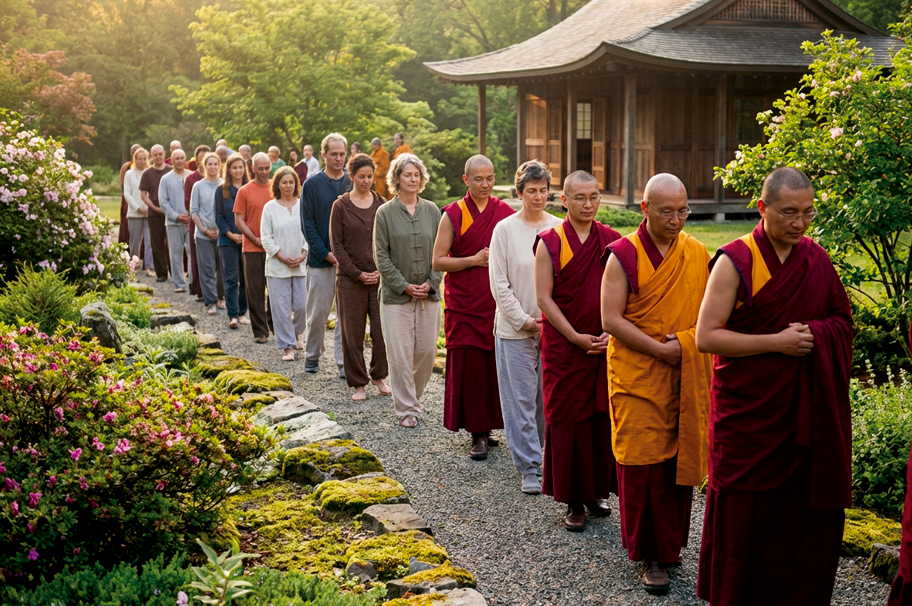
Walking Meditation (Kinhin/Cankama)
What it is: Meditation in motion—bringing the same quality of attention to walking.
Basic instruction:
- Stand at one end of your walking path
- Feel feet on ground, body standing
- Begin walking slowly (various speeds by tradition)
- Attend to sensations of lifting, moving, placing feet
- At path’s end, pause, turn mindfully, continue
- When mind wanders, return to sensations of walking
Why it matters:
- Bridges sitting and daily life
- Maintains alertness when sleepy
- Develops mindfulness in motion
- Gives body needed movement
Body Scan / Sweeping
What it is: Systematic attention through the body, observing sensations.
Basic instruction:
- Begin at top of head
- Move attention slowly through each body part
- Observe whatever sensations are present (or absence of sensation)
- Don’t try to change anything—just observe
- Continue through entire body
- Repeat, often with increasing subtlety
What you’re developing:
- Interoceptive awareness
- Equanimity with pleasant and unpleasant
- Direct experience of impermanence
Loving-Kindness (Metta) Meditation
What it is: Cultivation of goodwill toward self and others.
Basic instruction:
- Begin with yourself: “May I be happy, may I be peaceful, may I be free from suffering”
- Extend to a loved one
- Extend to a neutral person
- Extend to a difficult person
- Extend to all beings everywhere
What you’re developing:
- Positive emotional states
- Reduced self-criticism
- Connection with others
- Balance to insight practice
Dharma Study
What it is: Learning Buddhist teachings that contextualize practice.
Common topics:
- Four Noble Truths
- Eightfold Path
- Three Characteristics (impermanence, suffering, non-self)
- Five Hindrances
- Seven Factors of Awakening
- Dependent origination
Format:
- Dharma talks by teachers
- Reading assignments
- Discussion (in some retreats)
- Q&A sessions
The Noble Silence
Silence is central to most Buddhist meditation retreat experiences. Understanding it helps you embrace rather than endure it.
What Noble Silence Means
Typically includes:
- No talking (except with teachers)
- No eye contact or gestures
- No reading (except dharma texts, sometimes)
- No writing (except practice notes, sometimes)
- No phones, internet, or devices
- No music or entertainment
Why “noble”? The silence isn’t punishment—it’s a gift. It’s called “noble” because it supports the noble pursuit of awakening.
The Purpose of Silence
| Benefit | How Silence Helps |
|---|---|
| Energy conservation | Talking disperses mental energy needed for practice |
| Reduced distraction | No social dynamics to navigate |
| Inner listening | Space to hear your own mind |
| Equality | No hierarchy based on social skills |
| Continuity | Practice isn’t interrupted by conversation |
| Depth | Silence allows deeper states to emerge |
Working with Silence
First days: Silence may feel awkward, lonely, or boring. The mind craves stimulation and connection.
Middle days: Silence becomes comfortable. You notice how much energy talking usually consumes. Inner richness emerges.
Later days: Silence feels natural, even precious. You may dread returning to the noisy world.
Tips:
- Don’t make eye contact a big deal—just let it be natural
- If you need something practical, brief functional speech is usually okay
- Write notes to staff if needed
- The loneliness usually transforms into solitude (which is different)
Exceptions to Silence
You CAN (and should) speak:
- During scheduled teacher interviews
- In emergencies
- For essential practical needs (medical, safety)
- During designated Q&A periods
- If you’re struggling and need support
The point isn’t rigid rule-following—it’s creating conditions for practice. Teachers understand that sometimes communication is necessary.
Accommodations and Daily Life
Practical aspects of a Buddhist meditation retreat shape your experience significantly.
Typical Accommodations
| Type | Description | Pros | Cons |
|---|---|---|---|
| Shared dormitory | Multiple beds in one room | Affordable; community feeling | Less privacy; potential noise |
| Shared room | 2-4 people per room | Balance of cost and privacy | Still sharing space |
| Single room | Private room, shared bathroom | Privacy for rest; introvert-friendly | Higher cost |
| Private with bath | Own room and bathroom | Maximum privacy and comfort | Highest cost; not always available |
| Camping/cabin | Tent or rustic cabin | Nature immersion; affordable | Weather dependent; less comfortable |
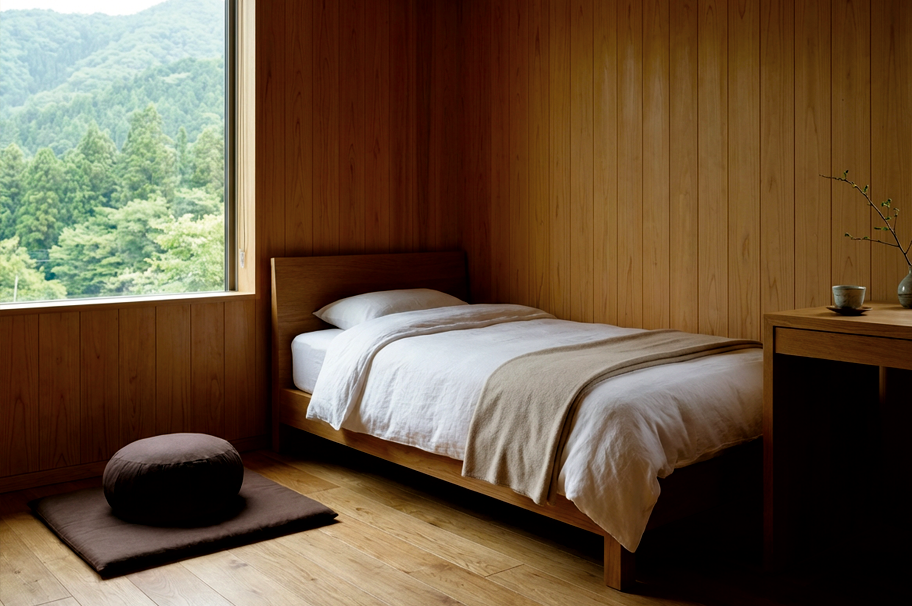
What Rooms Typically Include
- Simple bed with linens
- Storage space (shelf, closet, or hooks)
- Sometimes a desk or chair
- Meditation cushion (or available in hall)
- Minimal decoration
What rooms typically DON’T include:
- TV, radio, or entertainment
- Phone or internet access
- Excessive comfort or luxury
- Private meditation space (you’ll use the hall)
Food and Meals
Typical characteristics:
- Vegetarian (often vegan options)
- Simple, wholesome, nourishing
- Eaten in silence (mindful eating)
- Usually two main meals (breakfast, lunch)
- Light evening meal or tea
- No alcohol or intoxicants
Mindful eating practice:
- Eat slowly and attentively
- Notice flavors, textures, sensations
- Chew thoroughly
- Recognize the meal as practice, not break from practice
- Gratitude for the food and those who prepared it
Dietary needs:
- Most centers accommodate allergies and restrictions
- Communicate needs when registering
- Bring permitted snacks if you have specific requirements
Work Practice (Samu/Yogi Jobs)
Many retreats include a work period as part of practice.
Common tasks:
- Kitchen help (cooking, cleaning, dishes)
- Cleaning meditation hall or bathrooms
- Gardening or grounds maintenance
- Administrative tasks
- Meal service
Why work is practice:
- Mindfulness extends beyond the cushion
- Service to community (dana)
- Grounding and embodiment
- Balance to intensive sitting
- Humility and simplicity
Approach:
- Work silently and mindfully
- Bring same quality of attention as sitting
- Don’t rush to finish
- See the task as complete in itself
Common Challenges and How to Work with Them
Every Buddhist meditation retreat brings challenges. Knowing what to expect helps you work with them skillfully.
Physical Challenges
| Challenge | What’s Happening | How to Work with It |
|---|---|---|
| Knee/leg pain | Body not used to sitting posture | Use props; change positions mindfully; try bench or chair |
| Back pain | Core fatigue; posture issues | Adjust posture; use back support if needed; strengthen gradually |
| Sleepiness | Body adjusting; post-meal drowsiness | Open eyes; sit up straighter; stand or walk; it usually passes |
| Restlessness | Energy not yet settled | Walking meditation; patience; it settles with time |
| Headaches | Tension; caffeine withdrawal; concentration strain | Relax effort; drink water; rest; inform staff if persistent |
Mental Challenges
| Challenge | What’s Happening | How to Work with It |
|---|---|---|
| Racing thoughts | Mind’s habitual pattern becoming visible | Don’t fight; observe; return to anchor; this IS the practice |
| Boredom | Mind seeking stimulation | Get curious about boredom itself; it’s a doorway |
| Doubt | “Am I doing this right?” “Is this working?” | Classic hindrance; observe it as mental state; ask teacher |
| Planning/fantasy | Mind escaping present moment | Notice and return; don’t judge; very common |
| Resistance | Not wanting to practice | Stay with it; resistance often precedes breakthrough |
Emotional Challenges
| Challenge | What’s Happening | How to Work with It |
|---|---|---|
| Unexpected sadness | Suppressed emotions surfacing | Allow it; feel in body; let it move through; often healing |
| Anxiety/fear | Old patterns arising; unfamiliar territory | Ground in body; breathe; remember you’re safe; seek support |
| Anger/irritation | Aversion becoming visible | Observe without acting; explore what’s beneath; use metta |
| Grief | Losses being processed | Natural and healthy; allow tears; retreat is safe space |
| Overwhelm | Too much arising at once | Talk to teacher; take a break; ground in body; slow down |
The Five Hindrances
Buddhist teaching identifies five classic obstacles to meditation:
- Sensual desire: Craving pleasant experiences
- Ill-will: Aversion, anger, irritation
- Sloth and torpor: Sleepiness, dullness, lethargy
- Restlessness and worry: Agitation, anxiety, guilt
- Doubt: Uncertainty about practice, teacher, or path
Working with hindrances:
- Recognize them as impersonal mental states
- Name them: “This is restlessness”
- Don’t identify with them: They’re not “you”
- Apply appropriate antidote (e.g., metta for ill-will)
- Return to practice
When to Seek Help
Talk to a teacher if:
- You’re experiencing panic or severe anxiety
- Difficult emotions feel unmanageable
- You’re having thoughts of self-harm
- You feel dissociated or unreal
- Past trauma is overwhelming you
- You’re confused about the practice
- Something feels seriously wrong
There’s no shame in needing support. Teachers are there precisely for this.
Do You Need to Be Buddhist?
A common question about attending a Buddhist meditation retreat: Do you need to believe in Buddhism?
The Short Answer: No
Buddhist meditation retreats welcome sincere practitioners of any background—or no religious background at all. You don’t need to:
- Believe in Buddhist cosmology
- Accept reincarnation or karma
- Take refuge or become Buddhist
- Abandon your current faith
- Agree with everything taught
What IS Expected
| Expected | Not Expected |
|---|---|
| Sincere effort in practice | Belief in specific doctrines |
| Respect for the tradition | Conversion to Buddhism |
| Following retreat guidelines | Abandoning your own faith |
| Openness to teachings | Agreement with everything |
| Basic ethical conduct | Perfect understanding |
The Buddhist Approach
Buddhism is fundamentally empirical—the Buddha invited people to test his teachings through direct experience, not accept them on faith. The famous Kalama Sutta advises:
“Don’t accept something merely because it’s tradition, or because a teacher said it. When you know for yourselves that these qualities lead to welfare and happiness, then you should practice them.”
Different Levels of Engagement
Level 1: Technique only Take the meditation techniques, leave the philosophy. Many secular practitioners do this successfully.
Level 2: Technique + ethics Practice meditation and adopt Buddhist ethical guidelines (non-harming, honesty, etc.) without religious commitment.
Level 3: Technique + ethics + philosophy Engage with Buddhist teachings as a framework for understanding mind and reality.
Level 4: Full commitment Formally become Buddhist, take refuge, possibly ordain.
All levels are welcome at most retreats. You choose your depth of engagement.
If You Have Another Faith
Many Christians, Jews, Muslims, and practitioners of other faiths attend Buddhist retreats. Some find:
- Meditation deepens their existing faith
- Buddhist techniques complement their tradition
- No conflict between practice and belief
- Enriched spiritual life overall
Others find Buddhist philosophy compelling and shift their orientation. Both outcomes are valid.
Preparing for Your Buddhist Meditation Retreat
Proper preparation enhances your Buddhist meditation retreat experience.
Before You Book
Research the tradition:
- Understand which Buddhist tradition the retreat represents
- Read about the specific practices taught
- Know the teacher’s background and lineage
- Read reviews from past participants
Assess your readiness:
- Some meditation experience is helpful (even a few weeks)
- Physical ability to sit for extended periods
- Mental stability (active crisis = wait until stable)
- Realistic expectations
Ask questions:
- Is this retreat suitable for beginners?
- What’s the daily schedule?
- What’s the silence policy?
- Can I meet with a teacher individually?
- What are the accommodations like?
Physical Preparation
Build sitting tolerance:
- Practice sitting daily for increasing periods
- Experiment with postures (cross-legged, kneeling, chair)
- Note where discomfort arises
- Stretch hips, back, and legs regularly
Prepare your body:
- Get adequate sleep in weeks before
- Reduce caffeine if the retreat restricts it
- Eat well and stay hydrated
- Address any medical issues
Mental Preparation
Set intention:
- Why are you attending?
- What do you hope to learn or experience?
- What are you willing to let go of?
- Write this down
Adjust expectations:
- You won’t become enlightened in a week
- Difficulty is part of the process
- “Success” is showing up and practicing
- Trust the process
Practical Preparation
What to bring:
| Category | Items |
|---|---|
| Clothing | Comfortable, modest, loose layers; warm socks; shawl |
| Meditation | Cushion or bench (if you have a preferred one) |
| Personal | Toiletries; medications; earplugs; eye mask |
| Health | Any supplements; permitted snacks |
| Other | Journal (if allowed); alarm clock (phones usually prohibited) |
What NOT to bring:
- Books (except dharma texts, if allowed)
- Work or projects
- Entertainment
- Expectations of bliss
Logistical Preparation
- Confirm booking and arrival details
- Arrange transportation
- Inform family/work of limited contact
- Set up out-of-office messages
- Handle urgent matters before departure
- Arrive on time (or early)
After the Retreat: Integration
What happens after shapes the lasting impact of your Buddhist meditation retreat.
The Transition
Immediately after:
- You may feel open, sensitive, raw
- Ordinary life may seem loud and jarring
- Don’t rush back to full activity
- Protect your experience
The first week:
- Maintain daily practice (even 20 minutes)
- Limit stimulation (news, social media)
- Journal about insights
- Be patient with re-entry challenges
Establishing Home Practice
Start realistic:
- 20-30 minutes daily is sustainable
- Same time and place builds habit
- Morning often works best
- Consistency beats intensity
Create conditions:
- Dedicated meditation space
- Cushion or chair ready
- Timer (phone on airplane mode)
- Minimal distractions
Continue learning:
- Join a local sitting group (sangha)
- Read dharma books
- Listen to talks online
- Consider a teacher relationship
The Path Forward
A single retreat plants seeds. Ongoing practice grows them. Consider:
| Timeframe | Recommended Practice |
|---|---|
| Daily | 20-45 minutes sitting; mindfulness in activities |
| Weekly | Sitting group or longer solo sit |
| Monthly | Day-long retreat or practice day |
| Annually | Week-long (or longer) retreat |
Deepening Over Time
Progression for practitioners:
- First retreat: Learn basics, establish practice
- Subsequent retreats: Deepen technique, face subtler challenges
- Extended retreats: 2-4 weeks for significant deepening
- Long retreats: Months or years for serious practitioners
The path is lifelong. Each retreat is one step on a longer journey.
Learn more:
→ Meditation retreats for beginners
→ How to Prepare for Your First Spiritual Retreat
FAQ: Buddhist Meditation Retreat
Do I need to be Buddhist to attend a Buddhist meditation retreat? No. Buddhist retreats welcome sincere practitioners of any background. You don’t need to believe Buddhist doctrines or convert. What matters is genuine interest in the practice and willingness to follow retreat guidelines. Many people of other faiths (or no faith) attend Buddhist retreats and find the meditation techniques valuable without adopting Buddhist beliefs.
How long should my first Buddhist retreat be? For true beginners, 3-7 days is ideal. This provides enough time to learn fundamentals and settle into the rhythm without overwhelming commitment. Weekend retreats offer a taste but limited depth. The famous 10-day Vipassana courses are excellent but intense—consider a shorter retreat first if you’re completely new to meditation.
What if I can’t sit cross-legged? You don’t have to. Most retreats offer chairs, benches, and various cushion arrangements. The key is a stable, upright posture—not a specific leg position. Communicate any physical limitations when registering. Teachers have seen every body type and can help you find a workable posture.
Is the schedule really that strict? Yes, the schedule is meant to be followed. However, it’s not prison—it’s a container designed to support your practice. If you’re ill or struggling, teachers will accommodate you. The strictness serves a purpose: removing decisions so you can focus on practice. Most people find the structure liberating rather than oppressive.
What if I have a mental health condition? Disclose any mental health conditions when registering. Many people with anxiety, depression, or past trauma benefit from retreats, but the right retreat and proper support matter. Intensive silent retreats can sometimes be challenging for those with active conditions. Consult a mental health professional if unsure. If you’re in acute crisis, stabilize first.
Will I have to chant or bow to Buddha statues? This varies by tradition. Zen and Tibetan retreats often include bowing and chanting. Vipassana retreats typically have minimal ritual. You can usually participate at your comfort level—bowing can be done as a physical practice without religious meaning. Ask about ritual elements when researching retreats if this concerns you.
What if I want to leave early? You can technically leave, but it’s discouraged. The urge to leave is common (especially days 2-4) and usually passes. Talk to a teacher before deciding. That said, your wellbeing comes first—if you’re experiencing genuine crisis, leaving may be appropriate. Know the retreat’s policy on early departure and refunds.
How do I choose between traditions (Vipassana, Zen, Tibetan)? Consider your temperament. Analytical types often like Vipassana’s systematic approach. Those drawn to simplicity and discipline may prefer Zen. Devotional types or those wanting variety might enjoy Tibetan retreats. There’s no wrong choice—you can always try another tradition later. The best retreat is one you’ll actually attend and engage with fully.
Final Thoughts
A Buddhist meditation retreat is one of the most profound gifts you can give yourself. In a world of constant stimulation and distraction, you’re choosing to stop, to sit, to look within. You’re joining a practice that has guided countless beings toward freedom for over two millennia.
What awaits you is both simpler and more challenging than you might imagine. Simpler because the instructions are basic: sit, breathe, observe, return. More challenging because your mind will resist, your body will ache, and everything you’ve been avoiding will surface for attention.
But this is exactly the point. The retreat doesn’t create your difficulties—it reveals them. And in revealing them, it offers the possibility of freedom. Not freedom from life’s challenges, but freedom in the midst of them. Not escape from your mind, but a transformed relationship with it.
The Buddha didn’t promise that meditation would make life easy. He promised that it would make you free. Free from the tyranny of craving and aversion. Free from the prison of compulsive thinking. Free to respond to life with wisdom and compassion rather than reactivity and fear.
This freedom isn’t achieved in a single retreat. It’s cultivated over a lifetime of practice. But every journey begins with a first step, and a retreat is a powerful first step—or a powerful deepening of steps already taken.
The meditation hall is waiting. The cushion is waiting. The ancient teachings are waiting. Teachers who have walked this path are ready to guide you. Fellow seekers are ready to sit beside you in noble silence.
The only question is: Are you ready to begin?
The bell is about to ring. Take your seat.
Ready to experience a Buddhist meditation retreat?
We’ve curated Buddhist retreats worldwide—from beginner-friendly introductions to intensive silent practice.