Weight Loss Retreats vs. Fitness Bootcamps: What’s the Difference?

Affiliate Disclosure
We partner with retreat centers and booking platforms. When you book through our links, we may earn a commission at no extra cost to you. This supports our work and allows us to keep providing honest, in-depth reviews. Read our editorial policy
Table Of Content
- Affiliate Disclosure
- Introduction
- Quick Comparison: Weight Loss Retreats vs Fitness Bootcamps
- What Is a Weight Loss Retreat?
- What Is a Fitness Bootcamp?
- Detailed Comparison: Weight Loss Retreats vs Fitness Bootcamps
- Results Comparison
- Who Should Choose What?
- Cost Comparison
- Hybrid Options
- Questions to Ask Before Booking
- Red Flags for Each Type
- Making Your Decision
- What Happens After?
- FAQ: Weight Loss Retreats vs Fitness Bootcamps
- Final Thoughts
Introduction
You’ve decided to invest in yourself. You want to lose weight, get fit, and finally make a change that sticks. But as you research your options, you encounter two different worlds: weight loss retreats and fitness bootcamps. Both promise transformation. Both require commitment. Both cost significant money.
So what’s the difference? And more importantly, which one is right for you?
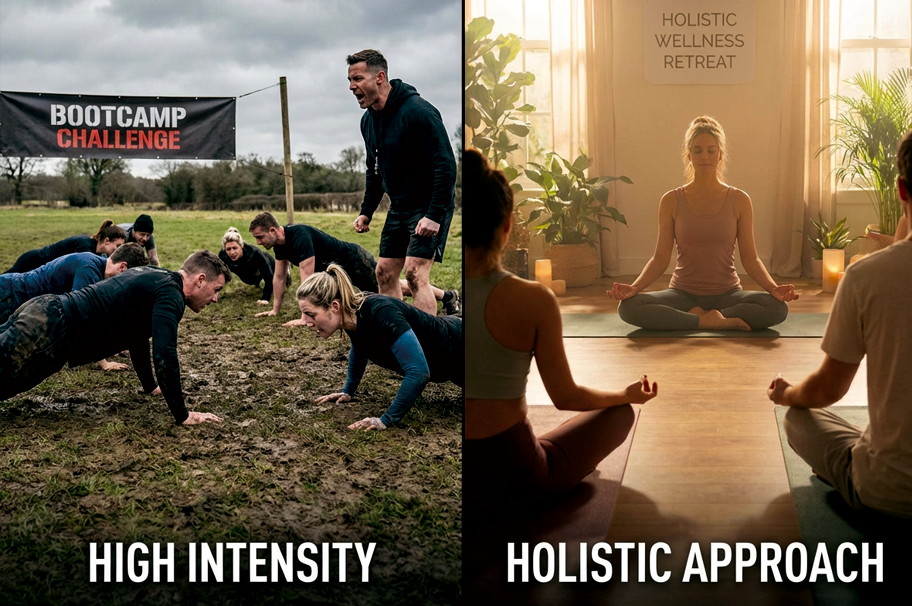
Understanding weight loss retreats vs fitness bootcamps isn’t just about comparing schedules or prices—it’s about understanding two fundamentally different philosophies of change. One emphasizes pushing through barriers with intensity and discipline. The other focuses on holistic transformation through balanced approaches.
This guide breaks down weight loss retreats vs fitness bootcamps in detail. We’ll compare their approaches, daily experiences, results, costs, and ideal candidates. By the end, you’ll know exactly which path aligns with your goals, personality, and body.
The right choice depends on who you are. Let’s figure that out together.
Quick Comparison: Weight Loss Retreats vs Fitness Bootcamps
Before diving deep, here’s the essential overview of weight loss retreats vs fitness bootcamps:
| Factor | Weight Loss Retreat | Fitness Bootcamp |
|---|---|---|
| Primary focus | Holistic lifestyle change | Intense physical training |
| Exercise intensity | Low to moderate | High to extreme |
| Daily exercise hours | 2-4 hours | 5-8+ hours |
| Approach to nutrition | Education and sustainable habits | Strict meal plans, calorie control |
| Psychological component | Often significant | Usually minimal |
| Atmosphere | Supportive, nurturing | Challenging, push-through |
| Pace | Gradual, sustainable | Intense, rapid |
| Typical duration | 1-4 weeks | 1-2 weeks |
| Ideal fitness level | Any level | Moderate to high |
| Weight loss rate | 1-3 lbs/week | 3-8 lbs/week |
| Long-term maintenance | Generally higher | Often challenging |
| Cost range | $1,500-10,000/week | $2,000-6,000/week |
What Is a Weight Loss Retreat?
To understand weight loss retreats vs fitness bootcamps, let’s first define each clearly.
Weight Loss Retreat Philosophy
Weight loss retreats take a holistic approach to transformation. The belief: lasting weight loss requires addressing not just exercise and diet, but also stress, emotional eating, sleep, mindset, and lifestyle habits.
Core principles:
- Sustainable change over rapid results
- Education for long-term independence
- Addressing root causes of weight gain
- Balance between challenge and restoration
- Mind-body connection
- Self-compassion alongside discipline
What Weight Loss Retreats Include
Fitness components:
- Yoga (various styles)
- Hiking and nature walks
- Swimming and water activities
- Light strength training
- Low-impact cardio
- Stretching and mobility
Nutrition components:
- Healthy, satisfying meals
- Cooking classes and demonstrations
- Nutrition education workshops
- Mindful eating practices
- Sustainable dietary guidance
Wellness components:
- Meditation and mindfulness
- Stress management techniques
- Sleep optimization
- Spa treatments (often)
- Emotional eating workshops
- Group support sessions
Sample Weight Loss Retreat Day
| Time | Activity |
|---|---|
| 7:00 AM | Morning meditation |
| 7:30 AM | Gentle yoga or stretching |
| 8:30 AM | Healthy breakfast |
| 10:00 AM | Fitness class (moderate intensity) |
| 11:30 AM | Nutrition workshop |
| 12:30 PM | Lunch |
| 2:00 PM | Free time / spa / rest |
| 4:00 PM | Nature hike or swimming |
| 5:30 PM | Restorative yoga |
| 6:30 PM | Dinner |
| 8:00 PM | Group session or journaling |
What Is a Fitness Bootcamp?
Now the other side of weight loss retreats vs fitness bootcamps.
Fitness Bootcamp Philosophy
Fitness bootcamps take an intensity-first approach. The belief: pushing your body hard, consistently, in a structured environment produces rapid physical transformation. Mental toughness is built through physical challenge.
Core principles:
- Challenge produces change
- Push past comfort zones
- Discipline and accountability
- No excuses mentality
- Rapid, visible results
- Physical transformation drives mental transformation
What Fitness Bootcamps Include
Fitness components:
- High-intensity interval training (HIIT)
- Circuit training
- Running and cardio drills
- Strength training
- Military-style exercises
- Competitive challenges
- Multiple sessions daily
Nutrition components:
- Strict meal plans
- Calorie-controlled portions
- Often high-protein focus
- Limited or no alcohol
- Sometimes detox elements
Mental components:
- Motivational coaching
- Accountability structures
- Goal-setting
- Team challenges
- Push-through mentality
Sample Fitness Bootcamp Day
| Time | Activity |
|---|---|
| 5:30 AM | Wake up |
| 6:00 AM | Morning run or cardio (60-90 min) |
| 7:30 AM | Breakfast |
| 9:00 AM | Strength training circuit (90 min) |
| 10:30 AM | Break |
| 11:00 AM | HIIT session (60 min) |
| 12:30 PM | Lunch |
| 2:00 PM | Active recovery or sports |
| 3:30 PM | Afternoon workout (60-90 min) |
| 5:00 PM | Stretching |
| 6:00 PM | Dinner |
| 7:30 PM | Evening activity or early rest |

Detailed Comparison: Weight Loss Retreats vs Fitness Bootcamps
Let’s examine each aspect of weight loss retreats vs fitness bootcamps in depth:
Exercise Approach
| Aspect | Weight Loss Retreat | Fitness Bootcamp |
|---|---|---|
| Intensity level | Low to moderate | High to extreme |
| Hours per day | 2-4 hours | 5-8+ hours |
| Types of exercise | Yoga, hiking, swimming, light cardio | HIIT, circuits, running, strength |
| Rest between sessions | Significant | Minimal |
| Modifications offered | Always | Sometimes |
| Competitive element | Rarely | Often |
| Injury risk | Low | Moderate to high |
Weight loss retreat approach: Exercise is one component of a broader program. Sessions are challenging but sustainable. Recovery is valued. The goal is establishing habits you’ll continue at home.
Fitness bootcamp approach: Exercise is the primary tool for transformation. Sessions are designed to push limits. Discomfort is expected and encouraged. The goal is maximum calorie burn and rapid physical change.
Nutrition Approach
| Aspect | Weight Loss Retreat | Fitness Bootcamp |
|---|---|---|
| Calorie level | Moderate deficit (1,400-1,800) | Often aggressive deficit (1,200-1,500) |
| Food philosophy | Whole foods, balanced, satisfying | High protein, strict portions |
| Education focus | High (cooking classes, workshops) | Low to moderate |
| Flexibility | Some accommodation | Usually strict |
| Hunger level | Manageable | Can be significant |
| Sustainability | Designed for long-term | Often hard to maintain |
Weight loss retreat approach: Learn to eat well, not just eat less. Meals are delicious and satisfying. Education helps you recreate this at home. The relationship with food is addressed.
Fitness bootcamp approach: Fuel the workouts, create calorie deficit. Portions are controlled. Meals are functional. The focus is on results, not culinary experience.
Psychological Component
| Aspect | Weight Loss Retreat | Fitness Bootcamp |
|---|---|---|
| Emotional eating addressed | Often central | Rarely |
| Stress management | Significant focus | Minimal |
| Therapy/counseling | Sometimes included | Rarely |
| Mindset work | Extensive | Motivation-focused |
| Self-compassion | Emphasized | Less emphasized |
| Group support | Therapeutic style | Team/competitive style |
Weight loss retreat approach: Why do you overeat? What triggers poor choices? How does stress affect your body? These questions are explored. Emotional patterns are addressed.
Fitness bootcamp approach: Push through mental barriers. Build discipline. Prove to yourself what you’re capable of. Mental toughness through physical challenge.
Atmosphere and Culture
| Aspect | Weight Loss Retreat | Fitness Bootcamp |
|---|---|---|
| Overall vibe | Nurturing, supportive | Challenging, intense |
| Staff approach | Encouraging, gentle | Motivating, pushing |
| Participant interaction | Supportive community | Team/competitive |
| Pace | Relaxed between activities | Fast, scheduled |
| Silence/reflection | Often included | Rarely |
| Luxury elements | Often | Sometimes |
Results Comparison
What can you expect from weight loss retreats vs fitness bootcamps?
During the Program
| Metric | Weight Loss Retreat | Fitness Bootcamp |
|---|---|---|
| Weekly weight loss | 1-3 lbs | 3-8 lbs |
| Inches lost | Gradual | Often dramatic |
| Energy levels | Stable, improving | Variable (fatigue common) |
| Hunger | Manageable | Can be intense |
| Soreness | Mild to moderate | Significant |
| Mood | Generally positive | Variable |
| Sleep | Often improves | Can be disrupted |
Long-Term Results
| Metric | Weight Loss Retreat | Fitness Bootcamp |
|---|---|---|
| Weight maintenance at 6 months | 50-70% maintain | 30-50% maintain |
| Weight maintenance at 1 year | 40-60% maintain | 20-40% maintain |
| Habit formation | Strong | Variable |
| Continued exercise | More likely | Less likely |
| Relationship with food | Often improved | Often unchanged |
| Return visits | Common | Common |
Why the Difference in Maintenance?
Weight loss retreat advantages for maintenance:
- Sustainable habits learned
- Emotional eating addressed
- Realistic exercise expectations
- Education for independence
- Gradual change is easier to maintain
Fitness bootcamp challenges for maintenance:
- Intensity not replicable at home
- Rapid loss often includes water/muscle
- Habits may not transfer
- Emotional patterns unchanged
- “All or nothing” mentality
Research from the American Journal of Lifestyle Medicine shows that programs emphasizing behavior change and psychological factors produce better long-term weight maintenance than exercise-focused programs alone.
Who Should Choose What?
The right choice in weight loss retreats vs fitness bootcamps depends on you:
Choose a Weight Loss Retreat If You:
✓ Have tried intense programs before and regained weight
✓ Struggle with emotional or stress eating
✓ Want to understand WHY you gained weight
✓ Prefer gradual, sustainable change
✓ Have injuries or physical limitations
✓ Are new to exercise or very unfit
✓ Value rest and recovery
✓ Want education, not just instruction
✓ Prefer nurturing over tough love ✓ Have significant stress in your life
✓ Want to address mind-body connection
✓ Are over 50 or have health concerns
Choose a Fitness Bootcamp If You:
✓ Already have a fitness base
✓ Respond well to intense challenges
✓ Want rapid, visible results
✓ Thrive in competitive environments
✓ Need external accountability and pressure
✓ Have a specific short-term goal (wedding, event)
✓ Enjoy military-style training
✓ Don’t have significant injuries
✓ Are mentally ready for extreme challenge
✓ Have successfully maintained weight loss before
✓ Want to push your physical limits
✓ Prefer action over reflection
Decision Matrix
| Your Situation | Best Choice |
|---|---|
| First time trying to lose weight seriously | Weight Loss Retreat |
| History of yo-yo dieting | Weight Loss Retreat |
| Emotional eater | Weight Loss Retreat |
| Already fit, want to get fitter | Fitness Bootcamp |
| Athlete wanting to cut weight | Fitness Bootcamp |
| Over 50 years old | Weight Loss Retreat |
| Under 35 and fit | Either (preference) |
| Health conditions | Weight Loss Retreat (medical) |
| High stress life | Weight Loss Retreat |
| Love intense workouts | Fitness Bootcamp |
| Hate intense workouts | Weight Loss Retreat |
| Want lasting lifestyle change | Weight Loss Retreat |
| Want rapid short-term results | Fitness Bootcamp |
Cost Comparison
Understanding the investment for weight loss retreats vs fitness bootcamps:
Price Ranges
| Type | Budget | Mid-Range | Premium |
|---|---|---|---|
| Weight Loss Retreat | $1,500-3,000/week | $3,000-6,000/week | $6,000-15,000/week |
| Fitness Bootcamp | $2,000-3,500/week | $3,500-5,000/week | $5,000-8,000/week |
What’s Typically Included
| Inclusion | Weight Loss Retreat | Fitness Bootcamp |
|---|---|---|
| Accommodation | ✓ | ✓ |
| All meals | ✓ | ✓ |
| Fitness classes | ✓ | ✓ |
| Nutrition guidance | ✓ | ✓ |
| Spa treatments | Often | Rarely |
| Cooking classes | Often | Rarely |
| Psychological support | Often | Rarely |
| Personal training | Sometimes | Often |
| Body composition analysis | Sometimes | Often |
| Aftercare program | Sometimes | Sometimes |
Value Considerations
Weight loss retreat value:
- More comprehensive approach
- Spa/wellness elements included
- Education has lasting value
- Better maintenance rates = better long-term ROI
- Often more luxurious experience
Fitness bootcamp value:
- More exercise hours per day
- Often includes personal training
- Rapid visible results
- Clear, measurable outcomes
- Intense accountability
Calculating True ROI
The real question isn’t “which costs less?” but “which produces lasting results?”
If a $5,000 weight loss retreat produces habits you maintain for years, that’s better value than a $3,000 bootcamp where you regain the weight in 3 months.
Consider:
- What have you spent on failed diets and programs?
- What’s the cost of weight-related health issues?
- What’s the value of feeling confident and healthy?
Hybrid Options
Can’t decide between weight loss retreats vs fitness bootcamps? Consider hybrid programs:
What Hybrid Programs Offer
Some programs combine elements of both approaches:
- Challenging workouts (but not extreme)
- Holistic wellness components
- Nutrition education AND strict meal plans
- Psychological support AND accountability
- Moderate intensity with push moments
Signs of a Good Hybrid
✓ Offers modifications for all fitness levels ✓ Includes emotional/psychological component ✓ Balances intense sessions with recovery ✓ Provides nutrition education, not just meal plans ✓ Has aftercare or follow-up support ✓ Staff includes both fitness and wellness professionals
Popular Hybrid Approaches
| Program Type | Description |
|---|---|
| Wellness bootcamp | Intense fitness with spa recovery and nutrition education |
| Active wellness retreat | Holistic retreat with more challenging fitness options |
| Transformation retreat | Comprehensive program addressing body, mind, and habits |
| Fitness and detox | Bootcamp intensity with cleansing nutrition focus |
Questions to Ask Before Booking
Whether choosing between weight loss retreats vs fitness bootcamps or evaluating specific programs:
Questions for Weight Loss Retreats
- What’s the balance between fitness, nutrition, and wellness?
- Do you address emotional eating and psychological factors?
- What education will I take home?
- How do you support long-term maintenance?
- What’s the fitness level of typical participants?
- Are there cooking classes or demonstrations?
- What spa or recovery treatments are included?
Questions for Fitness Bootcamps
- What’s the daily exercise schedule and intensity?
- What’s your injury rate?
- How do you modify for different fitness levels?
- What happens if I can’t complete a workout?
- What’s the nutrition plan and calorie level?
- How do you support transition back to normal life?
- What results do participants typically maintain long-term?
Questions for Both
- What are realistic results for someone like me?
- What’s included vs. extra cost?
- What’s your staff’s qualifications?
- Can I speak with past participants?
- What’s your cancellation policy?
- Do you offer aftercare or follow-up support?
- What makes your program different?
Red Flags for Each Type
Weight Loss Retreat Red Flags
🚩 No fitness component at all (just spa)
🚩 Promises unrealistic weight loss
🚩 No nutrition education, just meal provision
🚩 Unqualified staff
🚩 No structure or accountability
🚩 Focuses only on relaxation, not change
🚩 No aftercare or follow-up
Fitness Bootcamp Red Flags
🚩 No modifications offered for different levels
🚩 “No pain, no gain” as only philosophy
🚩 Extremely low calorie diets (under 1,200)
🚩 No medical screening
🚩 Shaming or humiliation tactics
🚩 Promises extreme weight loss (10+ lbs/week)
🚩 No rest days 🚩 Ignores injuries or pain
🚩 Staff without proper certifications
Making Your Decision
Here’s a framework for choosing between weight loss retreats vs fitness bootcamps:
Step 1: Honest Self-Assessment
| Question | If Yes → Retreat | If Yes → Bootcamp |
|---|---|---|
| Do I eat emotionally? | ✓ | |
| Do I love intense workouts? | ✓ | |
| Have I regained weight after diets? | ✓ | |
| Am I already fairly fit? | ✓ | |
| Do I need to understand my patterns? | ✓ | |
| Do I respond to tough love? | ✓ | |
| Do I have physical limitations? | ✓ | |
| Do I want rapid visible results? | ✓ | |
| Is stress a factor in my weight? | ✓ | |
| Do I thrive on competition? | ✓ |
Count your checkmarks. More in one column suggests your better fit.
Step 2: Consider Your History
- If past intense programs failed: Try a retreat approach
- If you’ve never really pushed yourself: Consider a bootcamp
- If you’ve lost and regained repeatedly: Retreat (address root causes)
- If you’ve maintained losses before: Either can work
Step 3: Be Honest About Your Goals
- “I want to look good for an event in 6 weeks” → Bootcamp
- “I want to change my life permanently” → Retreat
- “I want to get fit AND address my relationship with food” → Retreat or hybrid
- “I want to push my limits and see what I’m capable of” → Bootcamp
Step 4: Consider Practical Factors
- Time available: Bootcamps often shorter (1-2 weeks effective), retreats benefit from longer stays
- Budget: Compare total value, not just price
- Travel: Both available worldwide
- Health conditions: Retreats generally safer for medical issues
What Happens After?
The real test of weight loss retreats vs fitness bootcamps is what happens when you go home:
Transitioning from a Weight Loss Retreat
Advantages:
- Habits designed to continue at home
- Education helps you adapt to real life
- Sustainable exercise expectations
- Often includes aftercare support
- Psychological tools for challenges
Challenges:
- Slower results may feel less motivating
- Need to create your own structure
- No spa treatments at home!
Tips:
- Implement changes immediately
- Use recipes and techniques learned
- Continue meditation/mindfulness practice
- Stay connected with retreat community
- Schedule follow-up or return visit
Transitioning from a Fitness Bootcamp
Advantages:
- Visible results are motivating
- Proved what your body can do
- Built mental toughness
- May have improved fitness base
Challenges:
- Can’t replicate intensity at home
- May feel “normal” exercise is pointless
- Strict diet hard to maintain
- Emotional patterns unchanged
- Risk of “all or nothing” thinking
Tips:
- Accept that home workouts will be less intense
- Find a gym or trainer for accountability
- Gradually increase calories to maintenance
- Address emotional eating separately
- Plan for inevitable challenges
Learn more:
→ How to Choose the Right Weight Loss Retreat for Your Goals
FAQ: Weight Loss Retreats vs Fitness Bootcamps
Which produces faster weight loss? Fitness bootcamps typically produce faster scale results—often 3-8 lbs per week compared to 1-3 lbs at retreats. However, bootcamp losses often include more water weight and muscle, and are harder to maintain. Retreat losses, while slower, tend to be more sustainable.
Which is better for someone very overweight? Generally, weight loss retreats are safer and more appropriate for those with significant weight to lose (50+ lbs). The lower intensity reduces injury risk, and the psychological component addresses root causes. Medical weight loss retreats are ideal for those with obesity-related health conditions.
Can I do a bootcamp if I’m not fit? Some bootcamps accept beginners, but most assume a baseline fitness level. If you’re sedentary or very unfit, a bootcamp’s intensity could lead to injury, burnout, or failure. Start with a retreat or beginner-specific program, build a fitness base, then consider a bootcamp later.
Which has better long-term results? Research and industry data suggest weight loss retreats have better long-term maintenance rates—50-70% maintaining at 6 months vs. 30-50% for bootcamps. The difference is attributed to habit formation, psychological work, and sustainable approaches.
Are bootcamps safe? Quality bootcamps with proper screening, qualified trainers, and appropriate modifications are reasonably safe for healthy, moderately fit individuals. However, injury rates are higher than at retreats. Avoid programs that ignore pain, don’t offer modifications, or use shaming tactics.
Can I combine both approaches? Yes! Some people do a retreat first to address habits and emotional eating, then a bootcamp later to push fitness further. Or choose a hybrid program that combines elements of both. The key is matching the approach to your current needs.
Which is better value for money? Value depends on results, not price. A retreat that produces lasting change is better value than a cheaper bootcamp where you regain everything. Consider: what have you already spent on failed approaches? The program that finally works is the best value, regardless of cost.
I’ve failed at both before. What should I try? Consider what specifically didn’t work. If you lost weight but regained it, the maintenance piece was missing—look for programs with strong aftercare. If you couldn’t complete the program, it wasn’t the right fit for your current state. Be honest about what you need, not what you think you “should” do.
Final Thoughts
The debate of weight loss retreats vs fitness bootcamps isn’t about which is objectively better—it’s about which is better for you, right now, given your history, personality, and goals.
Fitness bootcamps work for people who thrive on intensity, have a fitness base, and need a short-term push. They build mental toughness and produce rapid visible results.
Weight loss retreats work for people who need to address root causes, want sustainable change, and benefit from a holistic approach. They build lasting habits and produce better long-term maintenance.
Neither is superior. Both have transformed lives. The key is honest self-assessment.
If you’ve tried the intense approach repeatedly and keep regaining weight, that’s data. Maybe it’s time to try something different. If you’ve never really challenged yourself physically, maybe a bootcamp is exactly the push you need.
Trust yourself. You know what you need. Choose the path that feels right—not the one that sounds impressive or punishing.
Your transformation is waiting. Choose wisely, commit fully, and trust the process.
Ready to find your perfect program?
Whether you’re drawn to the holistic approach of a weight loss retreat or the intensity of a fitness bootcamp, we’ve curated the best options worldwide.