Spiritual Retreats vs. Wellness Retreats: What’s the Difference?
Affiliate Disclosure
We partner with retreat centers and booking platforms. When you book through our links, we may earn a commission at no extra cost to you. This supports our work and allows us to keep providing honest, in-depth reviews. Read our editorial policy
Table Of Content
- Affiliate Disclosure
- Introduction
- The Core Difference: What Each Type Addresses
- Comparing Activities and Practices
- Philosophy and Worldview
- Outcomes and Benefits
- Who Should Choose Which?
- The Overlap: Hybrid Retreats
- Common Misconceptions
- Cost Comparison
- Making Your Decision: A Framework
- Can You Do Both? Combining Approaches
- FAQ: Spiritual Retreats vs Wellness Retreats
- Final Thoughts
Introduction
You’re ready for a retreat. You need time away, space to breathe, a chance to reconnect with yourself. But as you browse options, you notice two terms appearing everywhere: “spiritual retreat” and “wellness retreat.” Sometimes they seem interchangeable. Sometimes they feel worlds apart.
Understanding spiritual retreats vs wellness retreats matters because choosing the wrong type can leave you disappointed—or worse, in an experience that doesn’t serve your actual needs.
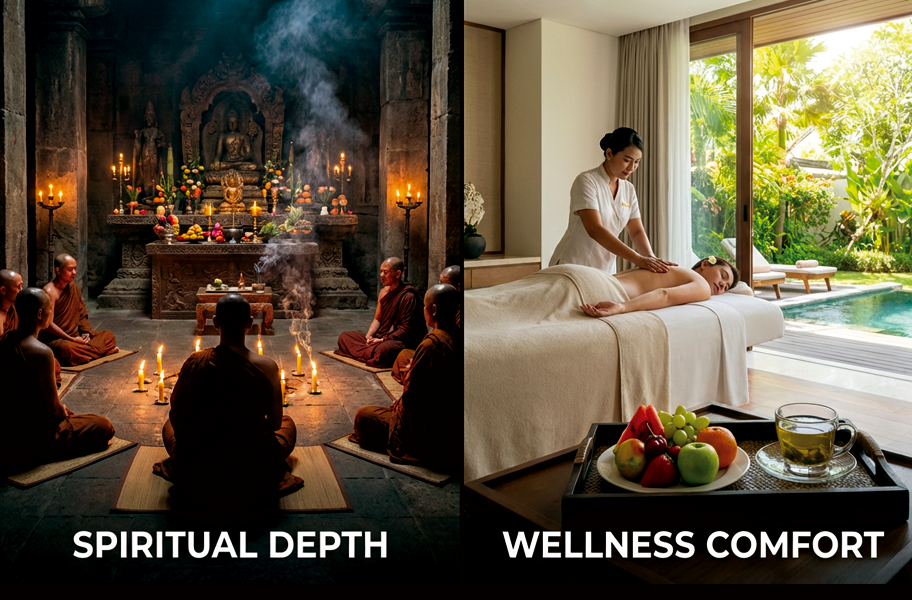
Here’s the short version: Wellness retreats focus on your body and mind—health, relaxation, stress relief, physical renewal. Spiritual retreats focus on your soul—meaning, purpose, transcendence, connection to something greater. Both are valuable. Both can be transformative. But they serve different hungers.
This guide provides a comprehensive comparison of spiritual retreats vs wellness retreats. We’ll explore the core differences in philosophy, activities, and outcomes. We’ll help you identify which type matches your current needs. And we’ll address the growing overlap between these categories, because many modern retreats blend elements of both.
By the end, you’ll know exactly which type of retreat is calling you—and why.
The Core Difference: What Each Type Addresses
The fundamental distinction in spiritual retreats vs wellness retreats lies in what they’re designed to address.
Wellness Retreats: Body and Mind
Primary focus: Physical health, mental well-being, stress relief, relaxation
Core question: “How can I feel better in my body and mind?”
Underlying assumption: You need rest, renewal, and optimization of your physical and mental health.
What wellness retreats address:
- Stress and burnout
- Physical tension and pain
- Unhealthy habits
- Weight and fitness
- Sleep issues
- Mental fatigue
- Need for relaxation
- Self-care deficits
Spiritual Retreats: Soul and Meaning
Primary focus: Inner transformation, meaning, purpose, connection to the sacred
Core question: “Who am I, and what is my relationship to something greater?”
Underlying assumption: You need depth, meaning, and connection beyond the material.
What spiritual retreats address:
- Existential questions
- Life purpose and direction
- Relationship with the sacred/divine
- Inner transformation
- Spiritual practices and growth
- Connection to something larger
- Death, meaning, and transcendence
- Soul-level healing
The Fundamental Distinction
| Dimension | Wellness Retreat | Spiritual Retreat |
|---|---|---|
| Primary focus | Body and mind | Soul and spirit |
| Goal | Feel better | Transform/awaken |
| Orientation | Horizontal (improve this life) | Vertical (connect to transcendent) |
| Success measure | Relaxation, health markers, stress reduction | Insight, meaning, spiritual connection |
| Worldview | Secular/scientific | Sacred/transcendent |
| Time horizon | Immediate relief and habits | Lifelong journey |
Comparing Activities and Practices
The daily experience differs significantly in spiritual retreats vs wellness retreats.
Typical Wellness Retreat Activities
| Category | Activities |
|---|---|
| Body treatments | Massage, facials, body wraps, hydrotherapy |
| Fitness | Yoga (fitness-focused), hiking, swimming, gym |
| Nutrition | Healthy meals, cooking classes, juice cleanses, detox programs |
| Relaxation | Spa time, pool, sauna, rest |
| Mind | Stress management workshops, sleep optimization, life coaching |
| Nature | Outdoor activities, nature walks, beach time |
The vibe: Resort-like, comfortable, nurturing, indulgent (in a healthy way)
Typical Spiritual Retreat Activities
| Category | Activities |
|---|---|
| Meditation | Sitting meditation, walking meditation, contemplative practice |
| Prayer/devotion | Chanting, prayer services, devotional practices |
| Teaching | Dharma talks, spiritual teachings, sacred texts study |
| Ceremony | Rituals, sacred ceremonies, rites of passage |
| Silence | Noble silence, solitude, inner listening |
| Self-inquiry | Journaling, reflection, spiritual direction |
| Community | Sharing circles, sangha, spiritual fellowship |
The vibe: Simple, contemplative, challenging, transformative
Side-by-Side Comparison
| Aspect | Wellness Retreat | Spiritual Retreat |
|---|---|---|
| Morning | Yoga class, healthy breakfast, spa appointment | Early meditation, simple breakfast, teaching |
| Afternoon | Fitness activity, treatment, pool time | Practice period, walking meditation, self-inquiry |
| Evening | Gourmet dinner, relaxation, social time | Evening practice, dharma talk, early bed |
| Silence | Optional quiet time | Often required or encouraged |
| Comfort level | High—luxury amenities | Variable—simplicity valued |
| Physical challenge | Moderate—fitness focused | Low—stillness focused |
| Mental challenge | Low—relaxation focused | High—confronting inner material |
| Social interaction | Encouraged | Limited or structured |
Philosophy and Worldview
The underlying philosophy shapes the entire experience in spiritual retreats vs wellness retreats.
Wellness Retreat Philosophy
Core beliefs:
- Health is holistic (body, mind, emotions)
- Stress and modern life create imbalance
- The body has innate healing capacity
- Self-care is essential, not selfish
- Prevention is better than cure
- You deserve to feel good
Approach to transformation:
- Optimize what exists
- Remove obstacles to health
- Build healthy habits
- Reduce stress and toxins
- Enhance quality of life
Typical frameworks:
- Integrative medicine
- Functional health
- Mind-body connection
- Positive psychology
- Lifestyle medicine
Spiritual Retreat Philosophy
Core beliefs:
- There is more to reality than the material
- Humans have a spiritual dimension that needs tending
- Suffering has meaning and can lead to growth
- Connection to the sacred/transcendent is possible
- Transformation requires surrender, not just effort
- The ego is not the deepest self
Approach to transformation:
- Transcend current limitations
- Die to old self, birth new self
- Connect to something greater
- Find meaning beyond comfort
- Embrace difficulty as teacher
Typical frameworks:
- Religious traditions (Buddhism, Christianity, Hinduism, etc.)
- Perennial philosophy
- Mystical traditions
- Indigenous wisdom
- Transpersonal psychology
How Philosophy Affects Experience
| Aspect | Wellness Retreat | Spiritual Retreat |
|---|---|---|
| Discomfort | Minimized—comfort is the goal | Embraced—growth requires challenge |
| Difficulty | Something to relieve | Something to learn from |
| Success | Feeling better | Seeing deeper |
| The self | To be cared for and optimized | To be transcended or transformed |
| Teachers | Experts in health/wellness | Guides in spiritual tradition |
| Community | Nice addition | Essential container |
Outcomes and Benefits
What you gain differs in spiritual retreats vs wellness retreats.
Wellness Retreat Outcomes
Immediate benefits:
- Deep relaxation
- Stress reduction
- Physical renewal
- Better sleep
- Increased energy
- Mental clarity
- Healthy habits initiated
Longer-term benefits:
- Sustained stress management
- Healthier lifestyle choices
- Improved self-care practices
- Better work-life balance
- Physical health improvements
- Mental health support
Research support: According to Global Wellness Institute, wellness tourism participants report significant improvements in stress levels, sleep quality, and overall well-being that can persist for weeks to months after retreats.
Spiritual Retreat Outcomes
Immediate benefits:
- Inner peace and stillness
- Clarity about life direction
- Spiritual experiences or insights
- Connection to something greater
- Release of old patterns
- Sense of meaning and purpose
Longer-term benefits:
- Deepened spiritual practice
- Transformed relationship with self
- Changed priorities and values
- Greater equanimity with life’s challenges
- Ongoing spiritual growth
- Sense of belonging to something larger
Research support: Studies published in Journal of Religion and Health show that spiritual retreat participants report lasting increases in meaning, purpose, and psychological well-being, with benefits persisting months to years later.
Outcome Comparison
| Outcome Type | Wellness Retreat | Spiritual Retreat |
|---|---|---|
| Physical | High—direct focus | Low to moderate—indirect |
| Mental | High—stress relief | Moderate—clarity through practice |
| Emotional | Moderate—relaxation | High—deep processing |
| Spiritual | Low—not primary focus | High—primary focus |
| Behavioral | Moderate—habit change | Variable—depends on integration |
| Existential | Low—not addressed | High—central focus |
Who Should Choose Which?
Matching your needs to the right type is essential when considering spiritual retreats vs wellness retreats.
Choose a Wellness Retreat If…
You’re experiencing:
- Burnout and exhaustion
- Physical tension and stress
- Need for rest and relaxation
- Desire to reset healthy habits
- Work-life imbalance
- General depletion
You want:
- To feel pampered and cared for
- Physical treatments and services
- Comfortable accommodations
- Healthy food and fitness
- Relaxation without intensity
- A break from stress
You’re NOT looking for:
- Deep inner work
- Confronting difficult emotions
- Religious or spiritual content
- Silence or solitude
- Challenging practices
Ideal wellness retreat candidate:
“I’m exhausted from work and life. I need to rest, recharge, and remember what it feels like to take care of myself. I want comfort, good food, and someone else to handle everything for a few days.”
Choose a Spiritual Retreat If…
You’re experiencing:
- Existential questions or crisis
- Longing for meaning and purpose
- Spiritual hunger or calling
- Major life transition
- Need for deep transformation
- Disconnection from your deeper self
You want:
- Inner transformation
- Connection to something greater
- Spiritual practices and teachings
- Time for deep reflection
- Community of seekers
- Guidance from spiritual teachers
You’re ready for:
- Discomfort in service of growth
- Confronting inner material
- Silence and solitude
- Simple accommodations
- Discipline and structure
Ideal spiritual retreat candidate:
“I’ve been successful by external measures, but something feels missing. I’m asking bigger questions about meaning, purpose, and what really matters. I’m ready to go deep, even if it’s uncomfortable.”
The Decision Framework
Ask yourself:
| Question | If Yes → Wellness | If Yes → Spiritual |
|---|---|---|
| Am I primarily physically exhausted? | ✓ | |
| Am I questioning life’s meaning? | ✓ | |
| Do I want to be pampered? | ✓ | |
| Am I seeking transformation? | ✓ | |
| Is relaxation my main goal? | ✓ | |
| Am I drawn to spiritual practice? | ✓ | |
| Do I want luxury and comfort? | ✓ | |
| Am I willing to face difficulty? | ✓ | |
| Is stress relief my priority? | ✓ | |
| Am I seeking connection to the sacred? | ✓ |

The Overlap: Hybrid Retreats
The lines blur in many modern offerings when comparing spiritual retreats vs wellness retreats.
Why Retreats Are Blending
Market forces:
- Consumers want both wellness and meaning
- “Spiritual but not religious” demographic growing
- Wellness industry incorporating mindfulness
- Spiritual centers adding comfort amenities
Philosophical shifts:
- Recognition that body, mind, and spirit are connected
- Yoga bridges physical and spiritual
- Meditation entered mainstream wellness
- Holistic health includes spiritual dimension
Types of Hybrid Retreats
| Type | Description | Balance |
|---|---|---|
| Yoga retreats | Physical practice with spiritual roots | 50/50 wellness-spiritual |
| Mindfulness retreats | Meditation in wellness context | 60/40 spiritual-wellness |
| Holistic health retreats | Body-mind-spirit integration | 60/40 wellness-spiritual |
| Transformational retreats | Personal growth with spiritual elements | 50/50 |
| Luxury spiritual retreats | Traditional practices, upscale setting | 70/30 spiritual-wellness |
| Wellness + meaning retreats | Spa plus purpose/coaching | 70/30 wellness-spiritual |
How to Evaluate Hybrid Retreats
Look at:
- What’s emphasized in the marketing?
- Who are the teachers/facilitators?
- What’s the daily schedule?
- How much silence/meditation?
- What’s the accommodation level?
- What tradition (if any) informs it?
Questions to ask:
- Is spiritual practice central or peripheral?
- Are teachers trained in spiritual traditions?
- Is there depth or just surface spirituality?
- Does the wellness aspect support or distract from inner work?
When Hybrids Work Well
Good hybrid retreats:
- Have clear intention and coherent philosophy
- Don’t dilute either dimension
- Teachers are qualified in their areas
- The blend serves the participant, not just marketing
- Physical wellness supports (rather than distracts from) inner work
Hybrids work well for:
- People new to spiritual work who want comfort
- Those who value body-mind-spirit integration
- Yoga practitioners seeking depth
- People who need both rest AND meaning
- Those transitioning from wellness to spiritual focus
When Hybrids Fall Short
Warning signs:
- Spirituality feels superficial or trendy
- “Wellness” is just luxury without substance
- No coherent philosophy connecting elements
- Teachers lack depth in spiritual traditions
- Marketing promises everything, delivers little
Hybrids may disappoint if you want:
- Deep, traditional spiritual practice
- Serious wellness/health intervention
- Rigorous meditation training
- Intensive detox or fitness program
- Authentic lineage-based teaching
Common Misconceptions
Clearing up confusion helps you navigate spiritual retreats vs wellness retreats.
Misconception 1: “Spiritual Retreats Are Religious”
Reality: Many spiritual retreats are secular or non-denominational. Buddhist meditation retreats often present teachings without religious framing. Contemplative retreats may draw from multiple traditions. You don’t need to be religious—or become religious—to attend a spiritual retreat. What matters is openness to inner exploration, not belief in specific doctrines.
Misconception 2: “Wellness Retreats Are Superficial”
Reality: Quality wellness retreats address real health needs with evidence-based approaches. Stress, burnout, and physical depletion are serious issues that deserve attention. There’s nothing superficial about caring for your body and mind. The best wellness retreats create lasting change in health behaviors and stress management.
Misconception 3: “Spiritual Retreats Are Uncomfortable”
Reality: While some spiritual retreats are austere, many offer comfortable (even beautiful) accommodations. Simplicity doesn’t mean suffering. The point isn’t discomfort for its own sake—it’s removing distractions so you can go inward. Many spiritual retreat centers have lovely rooms, good food, and beautiful settings.
Misconception 4: “Wellness Retreats Are Just Fancy Vacations”
Reality: A vacation is about escape and entertainment. A wellness retreat is about intentional health improvement. The structure, programming, and focus distinguish retreats from resorts. You return from a vacation rested; you return from a wellness retreat with new tools and habits.
Misconception 5: “You Have to Choose One Path”
Reality: Many people benefit from both types at different times. You might need a wellness retreat when burned out, and a spiritual retreat when questioning life’s meaning. They serve different needs—and those needs change over time. Some people alternate; others find their home in one type.
Misconception 6: “Spiritual Retreats Are Only for ‘Spiritual People'”
Reality: Everyone has a spiritual dimension, whether they use that language or not. Questions of meaning, purpose, mortality, and connection are universal human concerns. You don’t need to identify as “spiritual” to benefit from a spiritual retreat. Curiosity and openness are enough.
Cost Comparison
Budget considerations differ in spiritual retreats vs wellness retreats.
Wellness Retreat Costs
| Level | Duration | Typical Cost | What’s Included |
|---|---|---|---|
| Budget | 3-5 days | $500-$1,500 | Basic accommodation, meals, some classes |
| Mid-range | 5-7 days | $2,000-$4,000 | Nice accommodation, meals, treatments, classes |
| Luxury | 7+ days | $5,000-$15,000+ | Premium accommodation, gourmet meals, extensive treatments |
What drives cost:
- Location and accommodation quality
- Number and type of treatments
- Staff-to-guest ratio
- Food quality
- Brand/reputation
Spiritual Retreat Costs
| Level | Duration | Typical Cost | What’s Included |
|---|---|---|---|
| Dana/donation | 7-10 days | $0-$500 | Simple accommodation, meals, teaching |
| Budget | 5-7 days | $500-$1,500 | Basic accommodation, meals, teaching |
| Mid-range | 7-10 days | $1,500-$3,500 | Comfortable accommodation, meals, teaching |
| Luxury spiritual | 7+ days | $4,000-$10,000 | Upscale accommodation, gourmet meals, renowned teachers |
What drives cost:
- Tradition (some operate on donation)
- Teacher reputation
- Location
- Accommodation level
- Program intensity
Key Cost Differences
| Factor | Wellness Retreat | Spiritual Retreat |
|---|---|---|
| Base cost | Generally higher | Often lower |
| Dana/donation option | Rare | Common in Buddhist traditions |
| Treatments/services | Major cost driver | Usually not included |
| Accommodation | Often luxury | Often simple |
| Value perception | Paying for services | Paying for teaching/container |
| Scholarships | Rare | Sometimes available |
Value Considerations
Wellness retreats: You’re paying for services, amenities, and comfort. The value is tangible—treatments, food quality, accommodation.
Spiritual retreats: You’re paying for teaching, container, and transformation. The value is less tangible but potentially more lasting.
Neither is “better value”—they’re different investments serving different needs.
Making Your Decision: A Framework
Use this framework to choose between spiritual retreats vs wellness retreats.
Step 1: Identify Your Primary Need
Ask yourself: What am I actually hungry for right now?
| If You’re Hungry For… | Consider… |
|---|---|
| Rest and relaxation | Wellness retreat |
| Meaning and purpose | Spiritual retreat |
| Physical renewal | Wellness retreat |
| Inner transformation | Spiritual retreat |
| Stress relief | Wellness retreat |
| Spiritual connection | Spiritual retreat |
| Self-care and pampering | Wellness retreat |
| Life direction clarity | Spiritual retreat |
| Health optimization | Wellness retreat |
| Existential answers | Spiritual retreat |
Step 2: Assess Your Current State
Physical state:
- Exhausted/depleted → Wellness (body needs care first)
- Reasonably healthy → Either
Mental state:
- Stressed/overwhelmed → Wellness (stabilize first)
- Stable but questioning → Spiritual
Emotional state:
- Raw/fragile → Wellness (nurturing needed)
- Stable but seeking depth → Spiritual
Spiritual state:
- No current practice → Start with wellness or gentle spiritual
- Established practice → Spiritual retreat to deepen
Step 3: Consider Your Readiness
For spiritual retreats, honestly assess:
- Can I handle discomfort in service of growth?
- Am I willing to face difficult inner material?
- Can I follow a structured schedule?
- Am I open to teachings I might not agree with?
- Can I be in silence for extended periods?
If you answered “no” to several: Start with wellness or a gentle hybrid retreat.
Step 4: Trust Your Gut
After analysis, check in:
- What does my intuition say?
- What am I genuinely drawn to?
- What slightly scares me in a good way?
- What would I regret not doing?
Your deeper knowing often has the answer.
Step 5: Start Where You Are
There’s no wrong choice. Both types of retreats offer value. You can always try the other type later. The best retreat is the one you’ll actually attend and engage with fully.
Can You Do Both? Combining Approaches
Many people exploring spiritual retreats vs wellness retreats eventually experience both.
A Possible Progression
| Stage | Retreat Type | Purpose |
|---|---|---|
| First | Wellness or gentle hybrid | Rest, introduction to retreat format |
| Second | Yoga or mindfulness retreat | Bridge body and spirit |
| Third | Spiritual retreat | Deeper inner work |
| Ongoing | Alternate based on needs | Different medicine for different times |
When to Choose Each
Choose wellness when:
- You’re depleted and need restoration
- Life is demanding and you need relief
- You want to establish self-care habits
- You need a break without intensity
Choose spiritual when:
- You’re stable and ready for depth
- Life questions are pressing
- You want to deepen practice
- You’re ready for transformation
The Integrated Life
Ultimately, wellness and spirituality aren’t separate:
- A healthy body supports spiritual practice
- Spiritual grounding supports mental health
- Self-care is a form of self-respect
- Meaning and purpose support well-being
The question isn’t which is “better”—it’s which you need now.
Learn more:
→ How to Prepare for Your First Spiritual Retreat
FAQ: Spiritual Retreats vs Wellness Retreats
Can a wellness retreat be spiritual? Yes, especially if you bring spiritual intention to it. Any experience can become spiritual with the right orientation. Some wellness retreats include meditation, yoga, or reflection time that can be engaged spiritually. However, if you want explicit spiritual teaching and practice, choose a retreat designed for that. A spa day can be sacred, but it’s not the same as a meditation retreat.
Can a spiritual retreat improve my health? Often, yes—indirectly. Reduced stress, better sleep, and inner peace all benefit physical health. Many people report health improvements after spiritual retreats. However, if you have specific health goals (weight loss, fitness, detox), a wellness retreat with those programs will be more effective. Spiritual retreats prioritize inner transformation; health benefits are a side effect, not the focus.
I’m not religious. Can I attend a spiritual retreat? Absolutely. Many spiritual retreats are secular or welcome people of all backgrounds. Buddhist meditation retreats often present teachings without religious framing. Contemplative retreats may draw from multiple traditions without requiring belief. What matters is openness to inner exploration. Be clear about the retreat’s orientation before booking—some are explicitly religious, others are not.
Are wellness retreats worth the cost? That depends on what you value and need. Quality wellness retreats provide expert care, beautiful environments, and structured programs that create real change. The cost reflects services, amenities, and staff. If you’re burned out and need restoration, a wellness retreat can be a worthwhile investment in your health. Compare it to the cost of ongoing stress-related health issues.
Which type is better for beginners? Neither is inherently better—it depends on what you’re seeking. Wellness retreats are often more comfortable and less challenging, making them easier for first-timers. Spiritual retreats require more from you but offer different rewards. If you’re unsure, a gentle hybrid (like a yoga retreat) can be a good starting point. The best beginner retreat is one that matches your actual needs and interests.
How do I know if I need spiritual vs. wellness support? Check your symptoms. Physical exhaustion, stress, and burnout point to wellness needs. Existential questioning, meaning-hunger, and spiritual longing point to spiritual needs. Sometimes both are present—in which case, address the more urgent need first (usually physical/mental stability before deep spiritual work). When in doubt, a hybrid retreat can address both.
Can I create my own hybrid experience? Yes. You could attend a wellness retreat with personal spiritual practice (morning meditation, journaling, intention). Or attend a spiritual retreat and add self-care elements (rest, gentle movement, nourishing food). Many people customize their experience this way. Just be careful not to dilute either dimension—half-hearted approaches yield half-hearted results.
What if I choose wrong? You’ll still benefit. Even a “wrong” choice teaches you something about what you actually need. A wellness retreat when you needed spiritual depth will highlight that hunger. A spiritual retreat when you needed rest will show you the importance of self-care. There’s no wasted retreat—only information for next time. Trust your choice, engage fully, and learn from the experience.
Final Thoughts
The question of spiritual retreats vs wellness retreats isn’t about which is superior—it’s about which serves you now.
Wellness retreats honor the truth that you are a body that needs care. In a world that demands constant output, taking time to rest, restore, and nurture yourself isn’t indulgence—it’s wisdom. Your body is the vehicle for everything else. Caring for it is foundational.
Spiritual retreats honor the truth that you are more than a body. You have depths that need exploring, questions that need asking, connections that need making. The material world, however comfortable, doesn’t satisfy the soul’s hunger for meaning, purpose, and transcendence.
Both truths are true. Both needs are real.
The exhausted executive needs a wellness retreat before they can sit still long enough for spiritual practice. The comfortable but empty seeker needs a spiritual retreat to find what no spa can provide. The wise person knows which medicine they need when—and doesn’t judge either.
So ask yourself honestly: What am I actually hungry for? What does this moment in my life require? What would truly serve my growth and well-being?
Then choose accordingly. Choose the retreat that matches your real need, not the one that sounds impressive or comfortable. Choose depth over image. Choose what will actually help.
And remember: you can always choose differently next time. This isn’t your only retreat. It’s one step on a longer journey—a journey that includes both caring for your body and nourishing your soul.
Both paths lead home. Choose the one you need to walk today.
Ready to find your perfect retreat?
Whether you’re seeking wellness restoration or spiritual transformation, we’ve curated retreats worldwide to match your needs.