Healing Retreats: A Beginner’s Guide
Affiliate Disclosure
We partner with retreat centers and booking platforms. When you book through our links, we may earn a commission at no extra cost to you. This supports our work and allows us to keep providing honest, in-depth reviews. Read our editorial policy
Table Of Content
- Affiliate Disclosure
- Introduction
- What Are Healing Retreats?
- Types of Healing Retreats for Beginners
- What Happens at a Healing Retreat?
- How to Choose Your First Healing Retreat
- Red Flags to Avoid
- Preparing for Your First Healing Retreat
- During Your Healing Retreat
- After Your Healing Retreat: Integration
- Healing Retreats for Beginners: Recommended Starting Points
- Cost and Practical Considerations
- FAQ: Healing Retreats for Beginners
- Final Thoughts
Introduction
Something in you is ready for change. Maybe you’ve been carrying weight that’s no longer yours to hold. Maybe old wounds keep showing up in new situations. Maybe you simply know there’s more healing available than you’ve been able to access in daily life.
If you’re exploring healing retreats for beginners, you’re taking a meaningful step. The fact that you’re here, reading this, says something about your readiness—even if part of you still feels uncertain.
Healing retreats offer something rare: dedicated time and space for inner work, supported by skilled facilitators, surrounded by others on similar journeys. They create conditions for transformation that are difficult to replicate at home, where responsibilities and distractions constantly pull at your attention.
But the world of healing retreats can feel overwhelming. So many modalities. So many promises. How do you know what’s legitimate? How do you choose what’s right for you? What should you expect? How do you prepare?
This guide answers all of that. We’ll walk through everything beginners need to know about healing retreats—the different types, what actually happens, how to choose wisely, how to prepare, and how to integrate your experience afterward.
Your healing journey is already underway. Let’s help you take the next step with clarity and confidence.
What Are Healing Retreats?
Before diving into healing retreats for beginners, let’s establish what we’re talking about.
Healing Retreats Defined
A healing retreat is an immersive program designed to facilitate emotional, psychological, physical, or spiritual healing. Unlike wellness retreats (which focus on relaxation and self-care) or vacation (which focuses on enjoyment), healing retreats specifically address wounds, trauma, patterns, or blocks that limit your life.
Key characteristics:
- Intentional focus on healing (not just relaxation)
- Facilitated process (not self-directed)
- Immersive environment (removed from daily life)
- Structured program (not just amenities)
- Integration support (not just experience)
What Healing Retreats Are NOT
| Healing Retreats Are | Healing Retreats Are Not |
|---|---|
| Facilitated inner work | Spa vacations with nice amenities |
| Structured transformation | Unstructured time off |
| Supported by professionals | DIY self-help |
| Often challenging | Always comfortable |
| Focused on root causes | Focused on symptom relief |
| Beginning of a process | Quick fix or instant cure |
Who Attends Healing Retreats?
Common reasons people seek healing retreats:
- Processing grief or loss
- Healing from trauma (childhood, relationship, or other)
- Breaking free from addiction or destructive patterns
- Recovering from burnout or life transitions
- Healing relationship wounds
- Addressing anxiety, depression, or emotional struggles
- Seeking meaning after crisis
- Releasing what no longer serves
You don’t need to be “broken” to attend. Many people come simply because they sense there’s more freedom and aliveness available to them.
Types of Healing Retreats for Beginners
The world of healing retreats for beginners includes many approaches. Here’s an overview:
By Modality
| Type | Approach | Best For | Intensity |
|---|---|---|---|
| Trauma-Informed | Somatic work, EMDR, therapy | Processing specific trauma | Moderate-High |
| Breathwork | Conscious breathing techniques | Emotional release, altered states | High |
| Plant Medicine | Ayahuasca, psilocybin, etc. | Deep transformation, spiritual insight | Very High |
| Shamanic | Indigenous healing practices | Spiritual healing, soul retrieval | High |
| Somatic | Body-based healing | Stored trauma, chronic tension | Moderate |
| Grief & Loss | Structured grief processing | Bereavement, major losses | Moderate |
| Inner Child | Healing childhood wounds | Family patterns, early trauma | Moderate-High |
| Meditation-Based | Silent retreat, Vipassana | Mental patterns, self-awareness | Moderate |
| Holistic/Integrative | Multiple modalities combined | General healing, exploration | Varies |
By Intensity Level
Gentle Introduction (Best for Most Beginners):
- Holistic healing retreats
- Meditation-based healing
- Yoga and healing combined
- Nature-based healing
- Grief support retreats
Moderate Intensity:
- Somatic healing retreats
- Inner child work
- Breathwork (introductory)
- Trauma-informed (stabilization focus)
High Intensity (Consider After Some Experience):
- Intensive breathwork
- Shamanic healing
- Plant medicine ceremonies
- Deep trauma processing
By Duration
| Length | What to Expect | Best For |
|---|---|---|
| Weekend (2-3 days) | Introduction, single focus | Testing the waters, specific issue |
| Week (5-7 days) | Deeper immersion, multiple sessions | Meaningful transformation |
| Extended (10-14 days) | Profound depth, full process | Major life transitions, deep healing |
| Long-term (21+ days) | Complete immersion | Addiction recovery, intensive programs |
What Happens at a Healing Retreat?
Understanding what to expect helps beginners approach healing retreats with appropriate preparation.
Typical Elements
Most healing retreats include:
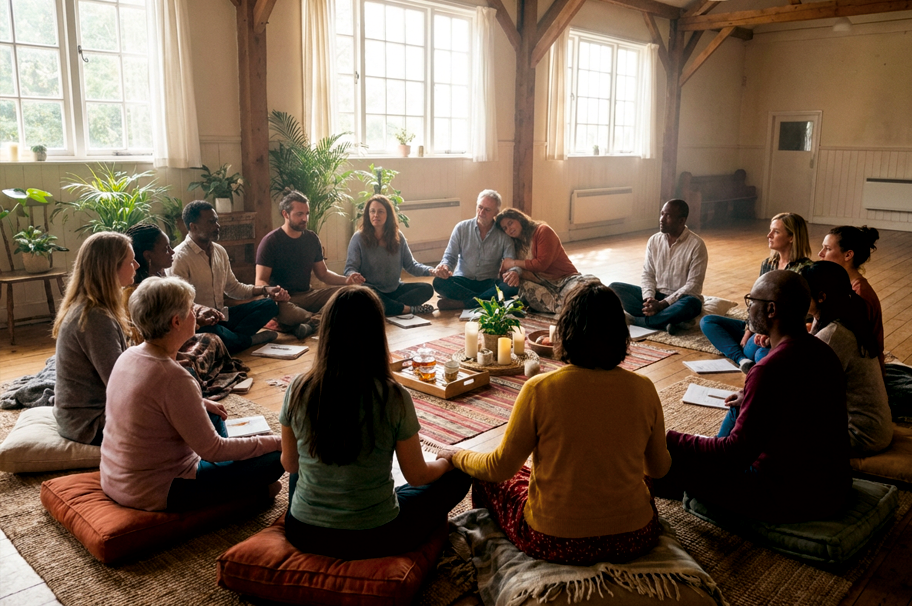
- Opening Circle
- Introductions and intention setting
- Guidelines and agreements
- Creating safe container
- Healing Sessions
- Core modality work (varies by retreat type)
- Individual and/or group format
- Facilitated by trained practitioners
- Integration Activities
- Journaling and reflection
- Sharing circles
- Rest and processing time
- Supporting Practices
- Meditation or mindfulness
- Movement (yoga, dance, walking)
- Time in nature
- Nourishing meals
- Closing Circle
- Sharing experiences
- Integration guidance
- Transition back to life
Sample Schedule: 5-Day Healing Retreat
| Time | Day 1 | Days 2-4 | Day 5 |
|---|---|---|---|
| 7:00 AM | — | Morning meditation | Morning meditation |
| 8:00 AM | — | Breakfast | Breakfast |
| 9:30 AM | — | Healing session | Integration workshop |
| 12:30 PM | — | Lunch | Lunch |
| 2:00 PM | Arrival | Rest/nature time | Closing circle |
| 4:00 PM | Welcome circle | Sharing circle | Departure |
| 6:00 PM | Dinner | Dinner | — |
| 8:00 PM | Opening ceremony | Evening practice | — |
The Healing Process
What actually happens during healing work:
According to Psychology Today, healing often involves:
- Safety — Establishing felt sense of security
- Stabilization — Building resources and coping capacity
- Processing — Working through difficult material
- Integration — Making meaning, incorporating changes
- Growth — Moving forward with new capacity
This isn’t linear. You may move between phases, revisit earlier stages, or experience multiple phases simultaneously.
Common Experiences
During healing retreats, people commonly experience:
| Experience | What It Means |
|---|---|
| Emotional release (crying, anger) | Stored emotions moving through |
| Physical sensations | Body releasing held tension |
| Memories surfacing | Unconscious material becoming conscious |
| Fatigue | System processing and integrating |
| Resistance | Protective parts activating |
| Breakthroughs | Shifts in understanding or feeling |
| Connection with others | Healing through relationship |
| Confusion | Old frameworks dissolving |
| Peace or clarity | Integration happening |
How to Choose Your First Healing Retreat
Choosing wisely is crucial for healing retreats for beginners. Here’s a framework:
Step 1: Clarify Your Intention
Ask yourself:
- What do I want to heal or address?
- What’s my primary goal for this retreat?
- What would “success” look like?
- What am I ready to face?
- What support do I need?
Write down your intention. This guides your choice and your experience.
Step 2: Assess Your Readiness
Consider honestly:
| Question | If Yes | If No/Unsure |
|---|---|---|
| Am I emotionally stable enough for intensive work? | Consider deeper modalities | Start gentler |
| Do I have support at home for after? | More options available | Ensure retreat offers integration |
| Am I doing this for myself (not to please others)? | Good motivation | Examine your reasons |
| Can I take time to integrate afterward? | Longer retreats possible | Choose shorter with integration focus |
| Have I done any inner work before? | More options available | Start with beginner-friendly |
Step 3: Match Modality to Need
| If You Want To… | Consider… |
|---|---|
| Process specific trauma | Trauma-informed, somatic |
| Release stored emotions | Breathwork, somatic |
| Heal childhood wounds | Inner child, family systems |
| Find spiritual meaning | Shamanic, meditation, plant medicine |
| Process grief | Grief-specific retreats |
| General healing/exploration | Holistic, integrative |
| Break addiction patterns | Specialized recovery retreats |
Step 4: Evaluate the Retreat
Essential questions:
About Facilitators:
- What training and credentials do they have?
- How many years of experience?
- What’s their personal healing journey?
- Are they trauma-informed?
- Do they have supervision or oversight?
About Safety:
- How do they screen participants?
- What’s the facilitator-to-participant ratio?
- How do they handle difficult experiences?
- Is medical support available if needed?
- What are the contraindications?
About Program:
- What’s the daily schedule?
- How much healing work vs. integration time?
- What modalities are used?
- What’s included in the price?
- What integration support is provided?
About Logistics:
- What’s the accommodation like?
- What food is provided?
- What’s the cancellation policy?
- What should I bring?
- How do I get there?
Step 5: Trust Your Gut
After research, check in with yourself:
- Does this feel right?
- Do I trust these facilitators?
- Does the approach resonate?
- Am I drawn to this or pushing myself?
Your intuition matters. If something feels off, honor that.
Red Flags to Avoid
Protect yourself when exploring healing retreats for beginners by watching for these warning signs:
Facilitator Red Flags
- ❌ No formal training or vague credentials
- ❌ Claims to heal everything or guarantee results
- ❌ Dismisses your concerns or questions
- ❌ Creates dependency rather than empowerment
- ❌ Boundary violations (sexual, financial, emotional)
- ❌ No supervision or accountability
- ❌ Cult-like dynamics or isolation from outside world
Program Red Flags
- ❌ No health screening or contraindication questions
- ❌ Very large groups with few facilitators
- ❌ No integration time or support
- ❌ Pressure to do more than you’re ready for
- ❌ Shaming or blaming participants
- ❌ Secrecy about methods or practices
- ❌ Mixing healing work with romantic/sexual dynamics
Marketing Red Flags
- ❌ “Miracle cure” or “instant transformation” promises
- ❌ Pressure tactics or artificial urgency
- ❌ No clear information about what’s involved
- ❌ Testimonials that seem too good to be true
- ❌ Attacking conventional therapy or medicine
- ❌ Claims that only their approach works
According to the American Psychological Association, legitimate healing practitioners welcome questions, respect boundaries, and don’t promise guaranteed outcomes.
Preparing for Your First Healing Retreat
Proper preparation helps beginners get the most from healing retreats.
Weeks Before
Practical preparation:
- Complete all required paperwork honestly
- Arrange time off work (including buffer after)
- Organize travel and logistics
- Inform loved ones of your plans
- Arrange support for responsibilities at home
Physical preparation:
- Reduce alcohol and substances
- Eat nourishing foods
- Get adequate sleep
- Gentle exercise and movement
- Address any health concerns
Mental/emotional preparation:
- Clarify and write down your intention
- Journal about what you hope to heal
- Notice fears and resistance (normal)
- Begin slowing down and turning inward
- Reduce media consumption and stimulation
Days Before
- Pack comfortable, layered clothing
- Bring journal and pen
- Gather any required items (list from retreat)
- Tie up loose ends at home/work
- Begin transition into retreat mindset
- Rest and don’t overschedule
What to Bring
Essentials:
- Comfortable clothing (layers)
- Journal and pens
- Toiletries and personal items
- Any required medications
- Meaningful object (optional)
- Photos or items for altar (if applicable)
Leave behind:
- Work materials
- Excessive devices (check retreat policy)
- Tight schedules or obligations
- Expectations of specific outcomes
- Judgment of yourself or the process
During Your Healing Retreat
Navigate your first healing retreat with these guidelines.
Showing Up Fully
Mindset for success:
- Be present rather than analyzing
- Stay open even when uncomfortable
- Trust the process and facilitators
- Participate fully in all activities
- Let go of how you think it “should” go
Working with Difficult Experiences
When things get hard (and they might):
| Experience | What to Do |
|---|---|
| Intense emotions | Let them move through; don’t suppress |
| Fear or resistance | Breathe, stay present, ask for support |
| Physical discomfort | Communicate with facilitators |
| Wanting to leave | Sit with it; often precedes breakthrough |
| Feeling nothing | Trust the process; not all healing is dramatic |
| Confusion | Normal; old frameworks are shifting |
Remember:
- You can always ask for support
- Facilitators are trained for difficult moments
- Discomfort often signals important work
- You can modulate your participation if needed
- Nothing is “wrong” with you if it’s hard
Connecting with Others
Group dynamics in healing retreats:
- Others’ stories may trigger your own material
- Witnessing others heal can catalyze your healing
- You don’t have to share more than feels right
- Confidentiality is essential (what’s shared stays)
- Connection itself is healing
Boundaries:
- It’s okay to need alone time
- You don’t have to process with everyone
- Romantic/sexual connections are discouraged
- Take space if you need it
- Ask for what you need
Self-Care During Retreat
- Rest when you need to
- Stay hydrated
- Eat nourishing food
- Spend time in nature
- Journal to process
- Move your body gently
- Ask for support when needed
After Your Healing Retreat: Integration
What happens after is as important as the retreat itself for beginners to healing work.
Why Integration Matters
The retreat is the beginning, not the end.
Common mistake: Having a powerful experience, returning to normal life immediately, and losing the benefits.
Integration means:
- Processing and making meaning of experiences
- Incorporating insights into daily life
- Maintaining practices learned at retreat
- Continuing the healing process
- Building on what was opened
The First Week After
Immediate post-retreat care:
| Do | Don’t |
|---|---|
| Keep a light schedule | Rush back to full responsibilities |
| Continue journaling | Make major life decisions |
| Rest and sleep well | Use alcohol or substances |
| Spend time in nature | Overprocess with everyone |
| Eat nourishing food | Expect to feel “fixed” |
| Be gentle with yourself | Judge your experience |
Common experiences:
- Feeling raw, open, or sensitive
- Vivid dreams
- Continued emotional processing
- Seeing life differently
- Feeling disconnected from “normal” life
- Waves of emotion
- Fatigue or unusual energy
Ongoing Integration
Weeks and months after:
- Maintain practices
- Continue meditation, journaling, or movement
- Use tools learned at retreat
- Create daily rituals that support healing
- Seek support
- Therapist or coach for ongoing work
- Integration circles or groups
- Connection with retreat community
- Trusted friends who understand
- Be patient
- Healing unfolds over time
- Changes may be subtle at first
- Old patterns may resurface (normal)
- Integration is measured in months, not days
- Notice changes
- How do you respond differently to triggers?
- What patterns have shifted?
- What feels more possible now?
- What still needs attention?
When to Seek Additional Support
Reach out if:
- Difficult emotions persist beyond 2-3 weeks
- You feel destabilized or unable to function
- Traumatic material needs professional processing
- You’re having thoughts of self-harm
- You feel more stuck than before
- Integration feels impossible alone
Resources:
- Retreat facilitators (most offer follow-up)
- Therapists trained in your retreat’s modality
- Integration specialists
- Somatic therapists
- Support groups
Healing Retreats for Beginners: Recommended Starting Points
If you’re new to healing retreats for beginners, consider these gentler entry points:
Best First Retreat Types
1. Holistic Healing Retreats
- Multiple gentle modalities
- Less intense than specialized retreats
- Good for exploration
- Usually include yoga, meditation, nature
2. Meditation-Based Healing
- Structured but gentle
- Builds self-awareness foundation
- Skills transfer to daily life
- Less emotionally intense
3. Nature-Based Healing
- Uses natural environment for healing
- Often includes forest bathing, hiking
- Gentle and grounding
- Good for those overwhelmed by intensity
4. Yoga and Healing Combined
- Familiar entry point for many
- Body-based but accessible
- Often includes emotional components
- Wide range of intensities available
5. Grief and Loss Retreats
- Specific focus (if applicable)
- Structured support
- Community of others in similar situations
- Often gentler approach
Building Your Healing Journey
A possible progression:
| Stage | Retreat Type | Purpose |
|---|---|---|
| First | Holistic or meditation-based | Learn basics, test readiness |
| Second | Modality-specific (somatic, breathwork) | Deeper work in chosen area |
| Third | Intensive (if called) | Profound transformation |
| Ongoing | Maintenance retreats | Continue growth, prevent backsliding |
You don’t have to follow this path. Some people are ready for intensive work immediately. Others prefer to stay with gentler approaches. Honor your own rhythm.
Cost and Practical Considerations
Understanding the practical side helps beginners plan for healing retreats.
Typical Costs
| Retreat Type | Duration | Price Range |
|---|---|---|
| Weekend workshop | 2-3 days | $300-$800 |
| Week-long healing | 5-7 days | $1,500-$4,000 |
| Intensive program | 10-14 days | $3,000-$8,000 |
| Luxury healing retreat | Varies | $5,000-$15,000+ |
| Plant medicine (international) | 7-14 days | $2,000-$6,000 |
What affects price:
- Location (Western countries cost more)
- Accommodation quality
- Facilitator expertise
- Program intensity and staffing
- Included services (meals, transport, etc.)
- Follow-up support
What’s Usually Included
Typically included:
- Accommodation
- All meals
- Program activities and sessions
- Basic materials
- Group facilitation
Often extra:
- Travel to/from retreat
- Individual sessions
- Specialized treatments
- Extended stay
- Gratuities
Making It Affordable
Options if budget is limited:
- Scholarship or sliding scale (many retreats offer)
- Work-exchange programs
- Local day retreats or workshops
- Payment plans
- Off-season pricing
- Shorter retreats to start
- Group discounts
Consider it an investment. Quality healing work can save years of struggle and thousands in therapy. The question isn’t just “can I afford this?” but “can I afford not to heal?”
Learn more:
→ How to prepare for a healing retreat
→ What to expect at Your First Breathwork Retreat
FAQ: Healing Retreats for Beginners
How do I know if I’m ready for a healing retreat? You’re likely ready if you feel called to deeper work, have some emotional stability, can take time away from responsibilities, and have support available afterward. You don’t need to be “healed enough” or have everything figured out—that’s what the retreat is for. If you’re in acute crisis or severely destabilized, work with a therapist first to build stability. Most retreat centers can help you assess readiness during their intake process.
What if I’m not sure what I need to heal? That’s okay and common. Many people attend healing retreats with a general sense that something needs to shift without knowing exactly what. Holistic or exploratory retreats are good for this. The healing process itself often reveals what needs attention. Set an intention like “I’m open to healing whatever most needs attention” and trust the process to guide you.
Will I have to share personal things with strangers? Most healing retreats include group sharing, but you control what and how much you share. Facilitators create safe containers with confidentiality agreements. You can share as much or as little as feels right. Many people find that sharing in a supportive group is itself deeply healing—but it’s never forced. If group work feels too vulnerable, look for retreats with more individual focus.
What if nothing happens or it doesn’t work? Healing isn’t always dramatic. Sometimes the most profound shifts are subtle—a slight softening, a new perspective, a small release. Trust that whatever happens (or doesn’t seem to happen) is part of your process. Benefits often emerge days or weeks later. That said, not every retreat is right for every person. If a particular approach doesn’t resonate, try a different modality rather than concluding that healing retreats don’t work.
Is it safe to do intensive healing work? Quality healing retreats with trained facilitators are generally safe. Risks increase with more intensive modalities (plant medicine, deep trauma work) and decrease with proper screening, qualified facilitators, and appropriate support. Always disclose health conditions, be honest in screening, and choose reputable retreats. If you have severe mental health conditions, consult your treatment provider before attending intensive retreats.
How is a healing retreat different from therapy? Healing retreats offer immersive, intensive experiences removed from daily life—something weekly therapy can’t provide. They often use body-based and experiential approaches rather than just talk. However, retreats aren’t a replacement for ongoing therapy. Many people find the combination powerful: retreats for breakthrough experiences, therapy for ongoing integration and support. Think of retreats as intensive catalysts within a longer healing journey.
Can I attend a healing retreat if I’m on medication? It depends on the medication and retreat type. Many retreats welcome people on psychiatric medication, though some (especially plant medicine) have strict contraindications. Always disclose all medications during screening. Some retreats work with your prescriber to ensure safety. Never stop medication without medical guidance, and be honest about what you’re taking—this is for your safety.
How do I explain this to family/friends who might not understand? You don’t owe anyone a detailed explanation. Simple framing: “I’m attending a wellness retreat to focus on my health and wellbeing.” For those who might understand more: “I’m doing some personal growth work at a retreat center.” Share details only with those who will be supportive. Some people find it helpful to have one trusted person who knows the full picture for support during integration.
Final Thoughts
Choosing to attend a healing retreat is an act of courage and self-love.
It says: I matter enough to dedicate time and resources to my healing. I’m willing to face what needs facing. I believe transformation is possible.
If you’re considering healing retreats for beginners, trust that impulse. Something in you knows that deeper healing is available—and is ready to receive it.
The path won’t always be comfortable. Healing rarely is. You may cry, shake, feel afraid, want to leave, wonder what you’ve gotten yourself into. This is normal. It’s what happens when we finally turn toward what we’ve been avoiding.
But on the other side of that discomfort is freedom. Relief. Aliveness. The ability to be present in your life without the weight of unprocessed pain.
You don’t have to have it all figured out. You don’t have to be ready for the most intensive experience. You just have to take the next step—whatever that is for you.
Maybe it’s a gentle weekend retreat. Maybe it’s a week-long immersion. Maybe it’s just continuing to research until you find what resonates.
Whatever your next step, take it. Your healing is worth it. You are worth it.
The journey of a thousand miles begins with a single step. And sometimes, that step leads to a healing retreat that changes everything.
Ready to begin your healing journey?
We’ve curated the best healing retreats worldwide—from gentle introductions to transformative immersions.