Healing vs Wellness Retreats: What’s the Difference?
Affiliate Disclosure
We partner with retreat centers and booking platforms. When you book through our links, we may earn a commission at no extra cost to you. This supports our work and allows us to keep providing honest, in-depth reviews. Read our editorial policy
Table Of Content
- Affiliate Disclosure
- Introduction
- The Core Difference: Healing vs Wellness Retreats
- What Wellness Retreats Offer
- What Healing Retreats Offer
- Healing vs Wellness Retreats: Detailed Comparison
- When to Choose a Wellness Retreat
- When to Choose a Healing Retreat
- The Overlap: Where Healing and Wellness Meet
- How to Decide: A Decision Framework
- Questions to Ask Before Booking
- Real Scenarios: Which Retreat Type Fits?
- Common Misconceptions
- Making Your Decision
- FAQ: Healing vs Wellness Retreats
- Final Thoughts
Introduction
You’re ready for a retreat. You know you need something—time away, a reset, transformation. But as you search, you encounter two terms that seem similar yet feel different: healing retreats and wellness retreats.
Understanding healing vs wellness retreats is essential for choosing the right experience. Pick the wrong type, and you might find yourself in a deep emotional processing program when you wanted a relaxing spa week—or vice versa.
These two retreat types serve different purposes, attract different people, and deliver different outcomes. Both are valuable. Neither is better. But one is right for you right now, and the other isn’t.
This guide breaks down the key differences between healing vs wellness retreats—what each offers, who they’re for, what to expect, and how to decide which matches your current needs. By the end, you’ll know exactly which type of retreat to book.
Let’s clarify the difference.
The Core Difference: Healing vs Wellness Retreats
At the most fundamental level, here’s the distinction:
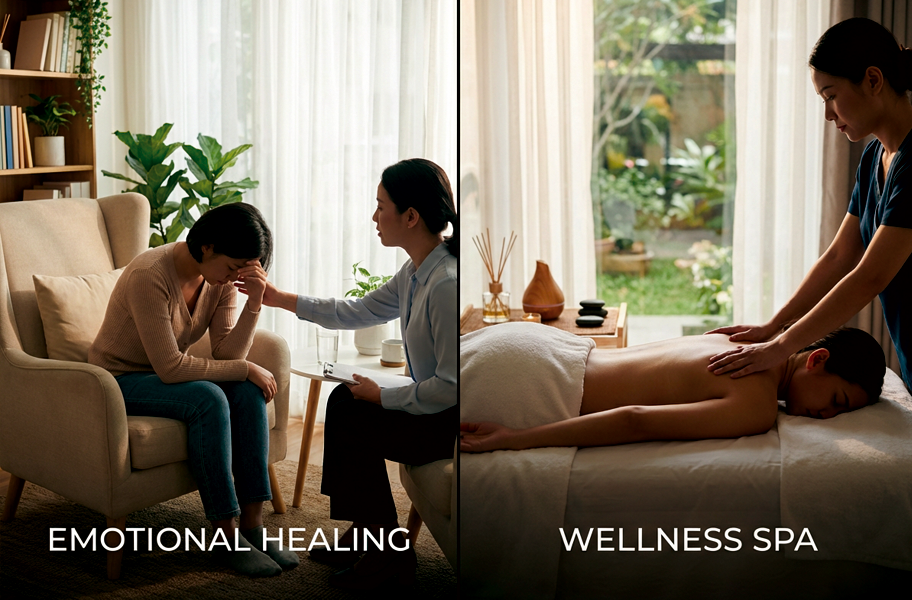
Wellness retreats focus on optimization—making a healthy person healthier, more relaxed, more balanced.
Healing retreats focus on transformation—helping someone process pain, trauma, grief, or stuck patterns to become whole.
| Aspect | Wellness Retreats | Healing Retreats |
|---|---|---|
| Primary focus | Relaxation, rejuvenation, optimization | Emotional processing, transformation, release |
| Starting point | “I want to feel better” | “I need to heal something specific” |
| Intensity | Gentle to moderate | Moderate to intense |
| Emotional depth | Surface to moderate | Deep |
| Main outcome | Refreshed, recharged, healthier habits | Transformed, released, new understanding |
| Typical duration | 3-14 days | 5-21 days |
| Aftercare needs | Minimal | Often significant |
Think of it this way: a wellness retreat is like a tune-up for a car that runs well. A healing retreat is like major repair work for a car that’s been damaged.
Both are necessary at different times. Both have value. The question is: what does your vehicle need right now?
What Wellness Retreats Offer
Wellness retreats focus on enhancing your overall wellbeing through relaxation, healthy practices, and self-care.
Typical Wellness Retreat Components
Body-focused:
- Spa treatments (massage, facials, body wraps)
- Yoga classes (various styles)
- Fitness activities (hiking, swimming, Pilates)
- Healthy cuisine and nutrition education
- Detox programs (juice cleanse, clean eating)
- Sleep optimization
Mind-focused:
- Meditation sessions (usually guided, accessible)
- Stress management workshops
- Digital detox
- Mindfulness practices
- Life coaching sessions
Lifestyle-focused:
- Cooking classes
- Nutrition consultations
- Fitness assessments
- Habit-building workshops
- Work-life balance strategies
The Wellness Retreat Experience
What a typical day looks like:
| Time | Activity |
|---|---|
| 7:00 AM | Morning yoga or meditation |
| 8:30 AM | Healthy breakfast |
| 10:00 AM | Spa treatment or fitness class |
| 12:30 PM | Lunch |
| 2:00 PM | Workshop or free time |
| 4:00 PM | Afternoon activity (hike, swim, class) |
| 6:30 PM | Dinner |
| 8:00 PM | Evening program or relaxation |
The atmosphere:
- Relaxed and nurturing
- Often luxurious settings
- Focus on comfort and pleasure
- Social but not intense
- Rejuvenating rather than challenging
Who Wellness Retreats Are For
Ideal candidates:
- People feeling stressed, tired, or burned out
- Those wanting to establish healthier habits
- Anyone needing a break from daily life
- People seeking relaxation and pampering
- Those wanting to jumpstart fitness or weight loss
- Anyone curious about wellness practices
Not ideal for:
- Those with significant trauma to process
- People in emotional crisis
- Those seeking deep psychological work
- Anyone needing intensive therapeutic support

What Healing Retreats Offer
Healing retreats focus on deep emotional, psychological, and sometimes spiritual transformation.
Typical Healing Retreat Components
Emotional processing:
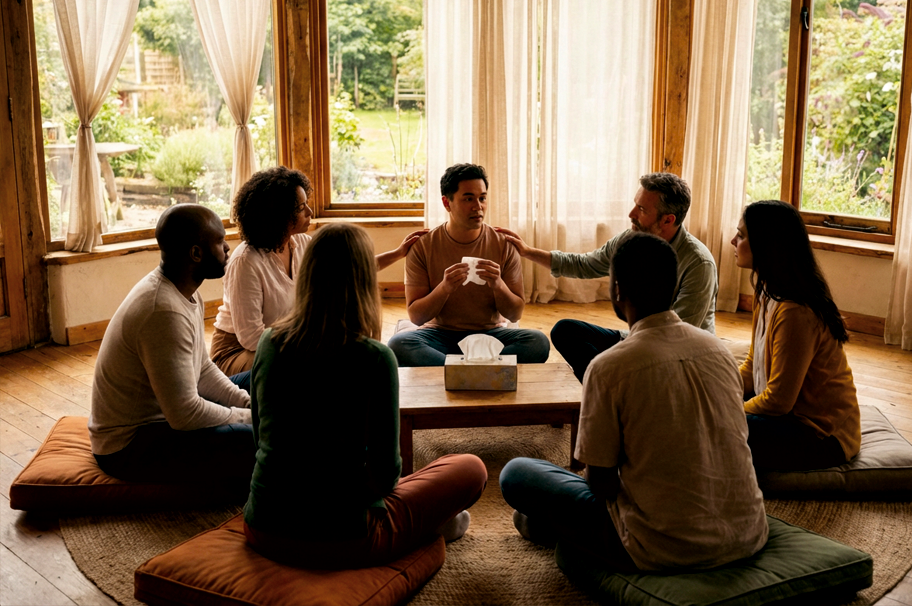
- Group therapy or sharing circles
- One-on-one sessions with facilitators
- Trauma-informed practices
- Grief work
- Inner child healing
- Shadow work
Somatic (body-based) healing:
- Breathwork (holotropic, transformational)
- Somatic experiencing
- Body-based trauma release
- Movement therapy
- Energy work (Reiki, etc.)
Psychological approaches:
- Parts work (IFS, etc.)
- Family constellation therapy
- EMDR or similar trauma therapies
- Psychodrama
- Narrative therapy
Spiritual dimensions:
- Ceremony and ritual
- Plant medicine (at some retreats)
- Meditation for healing
- Connection to nature
- Meaning-making and purpose work
The Healing Retreat Experience
What a typical day looks like:
| Time | Activity |
|---|---|
| 7:00 AM | Morning meditation or movement |
| 8:00 AM | Light breakfast |
| 9:30 AM | Group healing session (2-3 hours) |
| 12:30 PM | Lunch in silence or with sharing |
| 2:00 PM | Rest and integration time |
| 4:00 PM | Individual session or workshop |
| 6:00 PM | Dinner |
| 7:30 PM | Evening ceremony or group sharing |
The atmosphere:
- Safe but challenging
- Emotionally intensive
- Deeply supportive
- Intimate group connections
- Transformative rather than relaxing
Who Healing Retreats Are For
Ideal candidates:
- Those processing trauma, grief, or loss
- People stuck in repeating life patterns
- Those recovering from difficult relationships
- Anyone feeling emotionally blocked or numb
- People seeking deep self-understanding
- Those ready for significant life change
Not ideal for:
- Those in acute mental health crisis (seek professional help first)
- People wanting relaxation without emotional work
- Anyone not ready to face difficult emotions
- Those seeking a vacation or escape
According to the American Psychological Association, trauma-informed approaches are essential for safe healing work—quality healing retreats incorporate these principles.
Healing vs Wellness Retreats: Detailed Comparison
Let’s compare healing vs wellness retreats across key dimensions.
Intensity Level
| Wellness Retreats | Healing Retreats |
|---|---|
| Gentle to moderate | Moderate to intense |
| Comfortable throughout | Periods of discomfort |
| Relaxing | Challenging |
| Energizing | Can be depleting before energizing |
| Feel good during | May feel worse before better |
Emotional Depth
| Wellness Retreats | Healing Retreats |
|---|---|
| Surface-level relaxation | Deep emotional processing |
| Stress relief | Trauma release |
| Mood improvement | Emotional transformation |
| Feeling refreshed | Feeling fundamentally changed |
| Light emotional content | Heavy emotional content possible |
Facilitator Training
| Wellness Retreats | Healing Retreats |
|---|---|
| Yoga teachers, spa therapists | Psychotherapists, trauma specialists |
| Fitness instructors, nutritionists | Somatic practitioners, healers |
| Life coaches, wellness experts | Trained facilitators with clinical backgrounds |
| Hospitality-focused | Therapeutically-focused |
Group Dynamics
| Wellness Retreats | Healing Retreats |
|---|---|
| Social, friendly | Intimate, vulnerable |
| Optional sharing | Deep sharing often central |
| Privacy respected | Witnessing each other’s process |
| Surface connections | Profound bonds possible |
| Fun atmosphere | Sacred atmosphere |
Physical Environment
| Wellness Retreats | Healing Retreats |
|---|---|
| Often luxurious | Varies (simple to comfortable) |
| Spa facilities central | Therapy spaces central |
| Beautiful settings | Safe, contained settings |
| Comfort prioritized | Function prioritized |
| Resort-like | Sanctuary-like |
Cost Comparison
| Wellness Retreats | Healing Retreats |
|---|---|
| $200-$1,000+ per day | $200-$800+ per day |
| Luxury options expensive | Intensive programs can be costly |
| Spa treatments add up | Therapy sessions included |
| Often all-inclusive | Usually all-inclusive |
| Wide price range | Mid to high price range |
Outcomes
| Wellness Retreats | Healing Retreats |
|---|---|
| Relaxed and refreshed | Transformed and released |
| New healthy habits | New self-understanding |
| Reduced stress | Resolved trauma/grief |
| Better sleep, energy | Changed patterns and beliefs |
| Temporary reset | Lasting change (with integration) |
When to Choose a Wellness Retreat
Choose a wellness retreat when:
You Need Rest and Rejuvenation
Signs this is you:
- You’re exhausted from work or life demands
- You haven’t had a real break in too long
- You need to recharge your batteries
- You want to feel pampered and cared for
What you’ll get:
- Deep rest and relaxation
- Physical rejuvenation
- Mental clarity from stepping away
- Return refreshed and energized
You Want to Establish Healthy Habits
Signs this is you:
- You want to start a yoga or meditation practice
- You’re looking to improve your diet
- You want to learn stress management techniques
- You’re curious about wellness practices
What you’ll get:
- Introduction to various practices
- Skills you can take home
- Motivation and inspiration
- A healthy reset
You’re Generally Okay but Want Better
Signs this is you:
- Life is fine but could be better
- You’re not in crisis, just seeking improvement
- You want optimization, not repair
- You’re looking for enhancement, not healing
What you’ll get:
- Improved wellbeing
- New tools and practices
- Refreshed perspective
- Enhanced quality of life
You Want a Vacation with Benefits
Signs this is you:
- You want time away in a beautiful place
- You’d like some structure but also relaxation
- You want to return healthier than you left
- You’re looking for enjoyment plus improvement
What you’ll get:
- Beautiful environment and experiences
- Healthy food and activities
- Rest combined with growth
- A meaningful vacation
When to Choose a Healing Retreat
Choose a healing retreat when:
You’re Carrying Unprocessed Pain
Signs this is you:
- You have trauma that still affects you
- You’re grieving a loss (person, relationship, identity)
- You have emotional wounds that haven’t healed
- Past experiences still control your present
What you’ll get:
- Safe space to process pain
- Professional support for healing
- Release of what you’ve been carrying
- Beginning of genuine healing
You’re Stuck in Patterns
Signs this is you:
- You keep repeating the same relationship patterns
- You sabotage yourself in predictable ways
- You feel stuck despite trying to change
- You know something deeper needs to shift
What you’ll get:
- Understanding of your patterns
- Release of underlying causes
- Tools for new choices
- Breakthrough from stuck places
You Feel Disconnected from Yourself
Signs this is you:
- You feel numb or emotionally flat
- You’ve lost touch with who you really are
- You’re going through the motions of life
- You sense there’s more but can’t access it
What you’ll get:
- Reconnection with your authentic self
- Access to buried emotions and parts
- Renewed sense of aliveness
- Clarity about who you are
You’re Ready for Deep Change
Signs this is you:
- Surface-level changes haven’t worked
- You’re willing to face difficult truths
- You’re committed to doing the work
- You sense it’s time for transformation
What you’ll get:
- Profound personal transformation
- Lasting change (with integration work)
- New relationship with yourself
- Foundation for a different life
The Overlap: Where Healing and Wellness Meet
While healing vs wellness retreats are distinct, there’s overlap:
Retreats That Combine Both
Some retreats offer elements of both:
Integrative retreats:
- Wellness activities (yoga, spa, healthy food)
- Plus healing components (therapy, processing)
- Balanced intensity
- Suitable for those wanting both
Healing retreats with wellness elements:
- Core focus on healing work
- Supported by wellness practices
- Yoga and meditation as tools for healing
- Nourishing food and environment
Wellness retreats with depth:
- Primary focus on wellness
- Optional deeper workshops
- Some emotional content possible
- Gentle introduction to inner work
Practices That Serve Both
Some practices appear in both types:
| Practice | In Wellness Context | In Healing Context |
|---|---|---|
| Yoga | Exercise, flexibility, relaxation | Trauma release, emotional processing |
| Meditation | Stress relief, calm | Deep inquiry, accessing unconscious |
| Breathwork | Relaxation, energy | Emotional release, altered states |
| Massage | Relaxation, pampering | Somatic release, body memory |
When You Might Need Both
Sometimes the answer isn’t either/or:
Consider sequencing:
- Wellness retreat first to stabilize and rest
- Healing retreat later when resourced
- Or healing retreat first, wellness retreat to integrate
Consider your current state:
- Depleted? Start with wellness
- Stable but stuck? Ready for healing
- Unsure? Start gentler, go deeper later
How to Decide: A Decision Framework
Use this framework to choose between healing vs wellness retreats.
Step 1: Assess Your Current State
Ask yourself:
| Question | If Yes → Wellness | If Yes → Healing |
|---|---|---|
| Am I exhausted and need rest? | ✓ | |
| Do I have unprocessed trauma or grief? | ✓ | |
| Am I looking for relaxation? | ✓ | |
| Am I stuck in painful patterns? | ✓ | |
| Do I want to learn healthy habits? | ✓ | |
| Do I need to face something I’ve avoided? | ✓ | |
| Am I generally okay but want better? | ✓ | |
| Do I feel fundamentally blocked or broken? | ✓ |
Step 2: Consider Your Readiness
For healing retreats, ask:
- Am I stable enough for intensive work?
- Do I have support for after the retreat?
- Am I willing to feel uncomfortable?
- Can I take time to integrate afterward?
- Am I doing this for me (not to please others)?
If you answered “no” to any of these, consider starting with wellness.
Step 3: Check Your Resources
Practical considerations:
| Factor | Wellness | Healing |
|---|---|---|
| Time needed | 3-7 days often sufficient | 5-14 days recommended |
| Recovery time after | Minimal | Often significant |
| Cost | Varies widely | Mid to high |
| Emotional support after | Nice to have | Essential |
| Work flexibility | Standard vacation | May need extra time |
Step 4: Trust Your Intuition
After analysis, check in with yourself:
- What does your gut say?
- What are you drawn to?
- What feels right for this moment?
- What do you actually need (vs. what’s comfortable)?
Sometimes we’re drawn to wellness when we need healing (avoidance). Sometimes we’re drawn to healing when we need rest first (pushing). Be honest with yourself.
Questions to Ask Before Booking
Whether choosing healing vs wellness retreats, ask these questions:
For Any Retreat
- What is the daily schedule like?
- What qualifications do facilitators have?
- What’s the group size?
- What’s included in the price?
- What’s the cancellation policy?
- Are there reviews or testimonials?
For Wellness Retreats Specifically
- What spa treatments are included vs. extra?
- What styles of yoga/fitness are offered?
- What’s the food like?
- How much free time is there?
- What’s the accommodation standard?
- Is it social or more private?
For Healing Retreats Specifically
- What therapeutic modalities are used?
- What training do facilitators have?
- How is emotional safety maintained?
- What happens if someone is triggered?
- What integration support is provided?
- Are there contraindications I should know about?
- How do you screen participants?
According to Psychology Today, verifying facilitator credentials is essential when choosing any program involving psychological work.
Real Scenarios: Which Retreat Type Fits?
Let’s apply the healing vs wellness retreats framework to real situations:
Scenario 1: Sarah, 42, Marketing Executive
Situation: Burned out from work, hasn’t had a vacation in two years, feeling exhausted and disconnected from herself.
No major trauma, just depleted.
Best fit:Wellness retreat
- Focus on rest and rejuvenation
- Spa treatments and relaxation
- Yoga and meditation introduction
- Healthy food and nature
- Return refreshed and with new habits
Scenario 2: Michael, 35, Recently Divorced
Situation: Going through painful divorce, struggling with grief and anger, repeating relationship patterns he doesn’t understand.
Significant emotional content to process.
Best fit:Healing retreat
- Grief and loss processing
- Understanding relationship patterns
- Emotional release work
- Support from others in similar situations
- Tools for moving forward differently
Scenario 3: Elena, 28, Curious About Wellness
Situation: Generally happy and healthy, curious about yoga and meditation, wants to deepen her self-care practices.
No healing needed, seeking enhancement.
Best fit:Wellness retreat
- Learn yoga and meditation
- Explore various wellness practices
- Healthy lifestyle immersion
- Fun and inspiring environment
- Skills to take home
Scenario 4: David, 50, Childhood Trauma
Situation: Successful career but struggling with intimacy, anxiety, and a sense of emptiness. Knows childhood experiences are affecting him but has never addressed them.
Deep healing work needed.
Best fit:Healing retreat
- Trauma-informed program
- Inner child work
- Professional therapeutic support
- Safe space for deep processing
- Integration support after
Scenario 5: Lisa, 38, “Something’s Missing”
Situation: Life looks good on paper but feels empty. Not sure if she needs healing or just a reset. No obvious trauma but a persistent sense of disconnection.
Unclear—could be either.
Possible approach:
- Start with wellness retreat to rest and reflect
- Use that time to clarify what’s needed
- If deeper issues surface, consider healing retreat next
- Or choose an integrative retreat that offers both
Common Misconceptions
Let’s clear up confusion about healing vs wellness retreats:
Misconception 1: “Healing retreats are for broken people”
Reality: Healing retreats are for anyone carrying unprocessed experiences—which is most humans. Seeking healing is a sign of strength and self-awareness, not brokenness.
Misconception 2: “Wellness retreats are superficial”
Reality: Quality wellness retreats offer genuine benefits—stress reduction, healthy habits, rest, and rejuvenation. Not everything needs to be deep to be valuable.
Misconception 3: “I should do a healing retreat to really challenge myself”
Reality: Choosing intensity for its own sake isn’t wise. Match the retreat to your actual needs, not your ego’s desire to prove something.
Misconception 4: “Wellness retreats are just expensive vacations”
Reality: While some are vacation-like, quality wellness retreats offer structured programs, professional guidance, and lasting benefits beyond a typical holiday.
Misconception 5: “Healing retreats will fix everything”
Reality: Healing retreats are powerful but not magic. They’re often the beginning of a process, not the end. Integration and ongoing work are usually necessary.
Misconception 6: “I can’t afford a healing retreat, so wellness will do”
Reality: If you need healing, a wellness retreat won’t substitute. Consider saving longer, finding sliding-scale options, or doing therapeutic work at home first.
Making Your Decision
You now understand the difference between healing vs wellness retreats. Here’s how to move forward:
If You’re Leaning Toward Wellness
Next steps:
- Clarify what type of wellness (spa, yoga, detox, fitness)
- Determine your budget and timeframe
- Research retreats that match your preferences
- Read reviews and verify quality
- Book with confidence
Explore: Wellness Retreats →
If You’re Leaning Toward Healing
Next steps:
- Identify what you want to heal or process
- Research modalities that address your needs
- Verify facilitator credentials carefully
- Ensure you have post-retreat support
- Prepare thoroughly before attending
Explore: Healing Retreats →
If You’re Still Unsure
Options:
- Start with a wellness retreat and reassess after
- Choose an integrative retreat offering both
- Consult with a therapist about what you need
- Trust that clarity will come—you don’t have to decide today
Learn more:
→ How to prepare for a healing retreat
→ What to expect at Your First Breathwork Retreat
FAQ: Healing vs Wellness Retreats
Can I do a healing retreat if I’ve never done any therapy? Yes, but consider your readiness carefully. Healing retreats can be intense, and having some self-awareness and coping skills helps. If you’re new to inner work, consider starting with a gentler program or doing some therapy first. Many healing retreats welcome beginners but will screen to ensure you’re appropriate for their program.
Are wellness retreats just for women? No. While some wellness retreats market primarily to women, many welcome all genders. Men’s wellness retreats are increasingly common. Look for retreats that match your preferences—co-ed, women-only, or men-only options all exist.
How do I know if a healing retreat is legitimate? Check facilitator credentials (therapy licenses, certifications, training). Read reviews from past participants. Ask about their approach to safety and ethics. Legitimate retreats are transparent about their methods and happy to answer questions. Be cautious of programs making grandiose promises.
Can a wellness retreat turn into a healing experience? Sometimes. Relaxation and space can allow buried emotions to surface. Quality wellness retreats have staff who can support this if it happens. However, if you know you need healing work, choose a retreat designed for that rather than hoping it happens accidentally.
What if I start a healing retreat and it’s too intense? Good healing retreats allow you to modulate your participation. You can usually step back, take breaks, or work at a gentler pace. Communicate with facilitators—they’re trained to support you. That said, some discomfort is normal in healing work; distinguish between productive challenge and genuine overwhelm.
Are healing retreats covered by insurance? Rarely, though some therapeutic retreats may provide documentation for insurance claims. Most healing and wellness retreats are out-of-pocket expenses. Some offer payment plans or sliding scale fees. Consider it an investment in your health and wellbeing.
How often should I do retreats? For wellness: annually or as needed for reset and rejuvenation. For healing: as needed based on your process—some people do one transformative retreat; others return periodically for deeper work. Listen to your needs rather than following a formula.
Can couples do healing retreats together? Some healing retreats are designed for couples; others are individual-focused. If you’re processing relationship issues, a couples retreat may help. If you’re processing individual trauma, doing separate retreats might be better. Consider what you each need and whether doing the work together serves both of you.
Final Thoughts
The question of healing vs wellness retreats comes down to one thing: what do you actually need right now?
Not what sounds impressive. Not what others think you should do. Not what your ego wants. What does your whole self—body, mind, heart, spirit—actually need in this moment?
If you need rest, choose rest. There’s no prize for suffering when relaxation would serve you better.
If you need healing, choose healing. There’s no shortcut through avoidance when transformation is calling.
Both paths are valid. Both serve important purposes. Both can change your life in their own ways.
The wellness path says: You deserve care, rest, and nourishment. Come be restored.
The healing path says: You deserve freedom from what burdens you. Come be transformed.
Listen carefully. Your answer is already there.
Ready to find your perfect retreat?
Whether you need rejuvenation or transformation, we’ve curated the best retreats worldwide to match your needs.