Meditation Retreats for Beginners: Everything You Need to Know
Affiliate Disclosure
We partner with retreat centers and booking platforms. When you book through our links, we may earn a commission at no extra cost to you. This supports our work and allows us to keep providing honest, in-depth reviews. Read our editorial policy.
Table Of Content
- Affiliate Disclosure
- Introduction
- Why Do a Meditation Retreat?
- Is a Retreat Right for You?
- Types of Meditation Retreats
- How to Choose Your First Retreat
- What to Expect at a Beginner Retreat
- Common Beginner Fears (And the Truth)
- How to Prepare for Your First Retreat
- During the Retreat: Tips for Beginners
- Common Challenges (And How to Handle Them)
- What You’ll Gain
- After the Retreat
- FAQ
- The Invitation
Introduction
You’ve been curious about meditation. Maybe you’ve tried an app, sat a few times at home, or simply felt the pull toward something deeper. Now you’re considering a meditation retreat—but the options feel overwhelming, and honestly, a little intimidating.
Can you really sit in silence for days? Do you need to be “spiritual”? What if you can’t stop thinking? What if you’re the only beginner there?
Take a breath. Meditation retreats for beginners exist precisely because everyone starts somewhere. You don’t need experience, flexibility, or a calm mind. You just need willingness.
This guide covers everything a first-timer needs to know: how to choose the right retreat, what to expect, how to prepare, and how to get the most from your experience. By the end, you’ll have the confidence to book your first retreat—and the knowledge to thrive once you’re there.
Why Do a Meditation Retreat?
You can meditate at home. So why travel somewhere to sit in silence?
Depth You Can’t Get at Home
At home, distractions are everywhere: your phone, your to-do list, your refrigerator. A retreat removes all of that. Without the usual escapes, your practice goes deeper faster.
Expert Guidance
Retreats offer instruction from experienced teachers who can answer questions, correct misunderstandings, and guide you through challenges. This accelerates learning enormously.
Supportive Container
The structure of a retreat—the schedule, the silence, the community—creates a container that holds your practice. You don’t have to generate discipline; the environment provides it.
Dedicated Time
When did you last give yourself days of uninterrupted inner focus? A retreat is a radical act of self-care in a world that demands constant productivity.
Transformation
Something happens when you sit for extended periods without distraction. Insights arise. Patterns become visible. Peace becomes accessible. Many people describe their first retreat as life-changing.
Is a Retreat Right for You?
Meditation retreats aren’t for everyone—at least not right now. Here’s how to know if you’re ready:
You’re Probably Ready If:
- You’re curious about meditation and want to learn properly
- You’ve tried meditating at home but struggle with consistency
- You’re seeking a reset from stress, burnout, or life’s noise
- You’re willing to be uncomfortable in service of growth
- You can commit to following instructions and the schedule
- You’re in reasonably stable mental and emotional health
Consider Waiting If:
- You’re in acute mental health crisis (active psychosis, severe depression, recent trauma)
- You can’t commit to staying for the full retreat duration
- You’re looking for a relaxing vacation (retreats are rewarding, not relaxing)
- You’re not willing to follow the rules (silence, schedule, no devices)
- You have physical conditions that prevent sitting for extended periods (discuss with the center first)
No Experience Required
Here’s the truth: you don’t need meditation experience to attend a beginner retreat. That’s what “beginner” means. Many people’s first meditation happens on retreat—and they do fine.
What you need isn’t experience. It’s willingness.
Types of Meditation Retreats
Not all retreats are the same. Understanding your options helps you choose wisely.
By Tradition
| Tradition | Approach | Best For |
|---|---|---|
| Vipassana | Body scanning, breath awareness, insight | Those wanting systematic technique |
| Zen | Just sitting (shikantaza) or koan practice | Those comfortable with minimal instruction |
| Mindfulness (MBSR) | Secular, stress-reduction focused | Those preferring non-religious framing |
| Tibetan Buddhist | Visualization, mantra, devotional elements | Those drawn to ritual and imagery |
| Yoga & Meditation | Combines movement with sitting practice | Those wanting body-mind integration |
| Non-Denominational | Mixed techniques, flexible approach | Those wanting to explore without commitment |
By Duration
| Length | Experience Level | What to Expect |
|---|---|---|
| Weekend (2–3 days) | Perfect for beginners | Introduction, taste of retreat life |
| 5 days | Beginners welcome | Deeper experience, time to settle |
| 7 days | Some experience helps | Significant depth, challenging but accessible |
| 10 days | Committed beginners OK | Full immersion, transformative potential |
| 2+ weeks | Prior retreat experience recommended | Advanced practice, deep transformation |
By Intensity
- Gentle/Introductory: Shorter sits, more instruction, flexible schedule, some talking
- Moderate: Longer sits, noble silence, structured schedule
- Intensive: Extended silence, many hours of sitting, minimal breaks
For beginners: Start with gentle or moderate intensity, shorter duration (2–5 days).
How to Choose Your First Retreat
With so many options, how do you choose? Here’s a framework:
1. Start Shorter
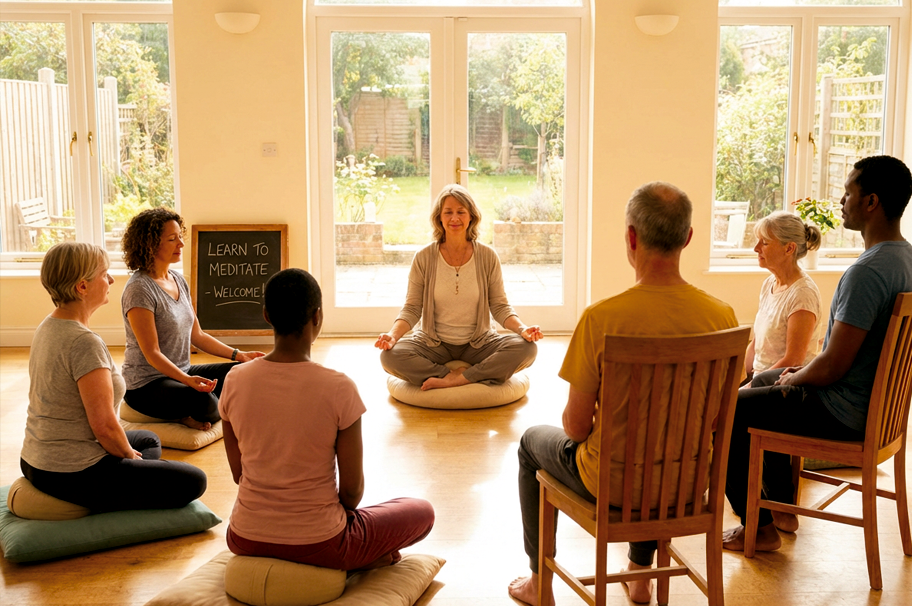
Your first retreat doesn’t need to be 10 days. A weekend or 5-day retreat offers meaningful experience without overwhelming commitment. You can always go longer next time.
2. Choose Beginner-Friendly Programs
Look for retreats explicitly designed for beginners or that welcome all levels. These offer:
- More instruction and guidance
- Shorter sitting periods
- More flexibility with posture
- Teachers experienced with newcomers
3. Consider the Tradition
Do you want:
- Clear, systematic technique? → Vipassana or mindfulness
- Simplicity without much instruction? → Zen (but can be challenging for beginners)
- Non-religious framing? → Secular mindfulness (MBSR-style)
- Movement alongside sitting? → Yoga and meditation retreats
If unsure, Vipassana or secular mindfulness are most accessible for beginners.
4. Check the Schedule
Review the daily schedule before booking:
- How many hours of sitting per day?
- How long are individual sits?
- Is there walking meditation, yoga, or movement?
- How much free time?
For beginners, look for schedules with sits of 30–45 minutes (not 60–90) and adequate breaks.
5. Assess the Silence Policy
Silence ranges from:
- Partial silence: Quiet during practice, talking allowed at meals/breaks
- Noble silence: No talking except to teachers
- Complete silence: No communication at all
For a first retreat, partial silence or noble silence with teacher access is ideal.
6. Research the Teachers
Good teachers make all the difference. Look for:
- Years of personal practice
- Training in the tradition they teach
- Experience with beginners
- Positive reviews from past participants
7. Consider Logistics
Practical factors matter:
- Location: How far? How difficult to reach?
- Cost: What’s included? Are scholarships available?
- Accommodation: Shared or private? Comfort level?
- Food: Dietary accommodations?
8. Trust Your Gut
After research, notice which retreat feels right. Intuition matters. If something feels off, honor that.
What to Expect at a Beginner Retreat
Knowing what’s coming reduces anxiety. Here’s the typical experience:
Arrival Day
- Check-in and registration
- Room assignment and orientation
- Introduction to the schedule and rules
- First meditation session (usually gentle)
- Silence often begins after dinner
Daily Structure
A typical day might look like:
| Time | Activity |
|---|---|
| 6:00 AM | Wake-up |
| 6:30–7:30 | Morning meditation |
| 7:30–8:30 | Breakfast |
| 9:00–10:30 | Meditation with instruction |
| 10:30–11:00 | Walking meditation or break |
| 11:00–12:00 | Meditation |
| 12:00–1:30 | Lunch and rest |
| 2:00–3:30 | Meditation or dharma talk |
| 3:30–4:00 | Break |
| 4:00–5:30 | Meditation |
| 5:30–6:30 | Dinner |
| 7:30–9:00 | Evening meditation or teaching |
| 9:30 | Lights out |
Beginner retreats typically have 5–7 hours of meditation daily (vs. 10+ at intensive retreats).
The Meditation
You’ll receive instruction on:
- Posture: How to sit (cushion, bench, or chair)
- Technique: What to do with your attention (breath, body, etc.)
- Working with thoughts: How to handle the busy mind
- Walking meditation: Slow, mindful movement between sits
Sits are usually 30–45 minutes for beginners, with breaks between.
Meals
- Simple, vegetarian food (usually)
- Eaten in silence (often)
- Mindful eating encouraged
- Dietary restrictions usually accommodated (communicate in advance)
Free Time
Rest periods allow for:
- Walking in nature
- Resting in your room
- Gentle stretching
- Simply being
Teacher Interaction
Most retreats offer:
- Group Q&A sessions
- Private interviews (sign up for a slot)
- Guidance during meditation sessions
Use these opportunities. Teachers expect questions from beginners.
Departure
- Final meditation session
- Silence ends
- Sharing circle (sometimes)
- Transition guidance
- Return to the world
Common Beginner Fears (And the Truth)
“I can’t sit still for that long”
Truth: Nobody can at first. That’s why you practice. Beginner retreats have shorter sits, and you can use a chair. Restlessness is normal—not a sign of failure.
“I can’t stop thinking”
Truth: Neither can anyone else. Meditation isn’t about stopping thoughts—it’s about changing your relationship to them. A busy mind is the starting point, not a disqualification.
“I’m not flexible enough to sit cross-legged”
Truth: You don’t have to. Chairs are always available. Meditation is about the mind, not pretzel-shaped legs.
“I’m not spiritual/religious”
Truth: Many retreats are secular. Even Buddhist-rooted retreats don’t require belief—just willingness to try the techniques. You can leave the philosophy and take the practice.
“What if I can’t handle the silence?”
Truth: Silence is uncomfortable at first, then liberating. Most people discover they love it. And you’re not truly alone—you’re surrounded by others on the same journey.
“What if I’m the only beginner?”
Truth: At beginner retreats, everyone is new or nearly so. Even at mixed-level retreats, beginners are common and welcomed. Teachers are skilled at meeting you where you are.
“What if I want to leave?”
Truth: You can leave—but try not to. The urge to flee usually peaks around Day 2–3, then passes. Commit before you go, and honor that commitment.
How to Prepare for Your First Retreat
Weeks Before
Start meditating at home: Even 10–15 minutes daily helps. Use an app (Insight Timer, Headspace) or simply sit and breathe. This builds familiarity with the practice.
Reduce stimulation gradually:
- Less social media and screen time
- Less caffeine (avoid withdrawal headaches on retreat)
- More quiet time alone
- Earlier bedtimes
Handle logistics:
- Arrange time off work
- Inform family you’ll be unreachable
- Set up out-of-office messages
- Arrange pet/plant care
Read the retreat materials: Most centers send preparation information. Read it carefully. Follow any pre-retreat guidelines.
What to Pack
Clothing:
- Comfortable, loose layers (you’ll sit for hours)
- Warm layers (meditation halls can be cold)
- Modest clothing (respect the environment)
- Comfortable walking shoes
- Slippers for indoors
Meditation supplies:
- Your own cushion or bench (optional—most centers provide)
- Shawl or blanket for warmth during sits
- Eye mask and earplugs (for sleeping)
Personal items:
- Toiletries (unscented preferred)
- Medications
- Alarm clock (phones usually surrendered)
- Water bottle
What NOT to bring:
- Books, magazines, work
- Excessive luggage
- Expectations of entertainment
Mindset Preparation
Set an intention: Not a goal—an intention. Something like:
- “I’m here to learn.”
- “I’m open to whatever arises.”
- “I’m practicing being present.”
Release expectations: You might not have a breakthrough. You might not feel blissful. You might struggle the whole time. All of this is valid. The practice works regardless of how it feels.
Commit to staying: Decide before you arrive: you will complete the retreat. This commitment carries you through the hard moments.
During the Retreat: Tips for Beginners
Follow the Schedule
The structure is your friend. Even when you don’t feel like meditating, show up. The discipline of following the schedule is part of the practice.
Ask Questions
Teachers expect beginners to have questions. Use Q&A sessions and private interviews. No question is too basic. Common beginner questions:
- “Am I doing this right?”
- “What do I do when my mind wanders?”
- “Is it normal to feel [emotion]?”
- “How do I handle physical pain?”
Be Kind to Yourself
Your mind will wander. You’ll feel restless. You’ll wonder why you came. This is completely normal. Self-criticism doesn’t help—self-compassion does.
When you notice you’ve been lost in thought for 20 minutes, that moment of noticing is the practice. You didn’t fail. You succeeded.
Work with Discomfort
Physical discomfort is inevitable. Mental discomfort too. The practice isn’t about eliminating discomfort—it’s about learning to be with it.
That said:
- Adjust your posture if pain is severe
- Use a chair if needed
- Stretch during breaks
- Communicate with teachers if something feels wrong
Stay Present
Don’t count the days. Don’t fantasize about the food you’ll eat when you leave. Don’t replay conversations from last week. These mental escapes prevent the depth you came for.
When you notice yourself time-traveling, gently return to now. This breath. This moment. This sit.
Trust the Process
The technique works—even when it doesn’t feel like it. Your job isn’t to evaluate your progress. Your job is to practice. Trust the process and keep showing up.
Use Rest Periods Wisely
Breaks aren’t for mental escape. Use them for:
- Slow, mindful walking
- Gentle stretching
- Resting (actually resting, not planning)
- Being in nature
Avoid using breaks to mentally check out or fantasize about life after the retreat.
Common Challenges (And How to Handle Them)
Restlessness
What it feels like: Can’t sit still. Urge to move, leave, do something—anything.
What helps:
- Remember: this is temporary
- Focus on physical sensations of restlessness itself
- Use walking meditation to discharge energy
- Shorten your sits if allowed
Sleepiness
What it feels like: Nodding off during meditation. Struggling to stay awake.
What helps:
- Open your eyes slightly
- Sit up straighter
- Take a few deep breaths
- Splash cold water on your face during breaks
- Ensure you’re sleeping enough at night
Racing Mind
What it feels like: Thoughts won’t stop. Planning, remembering, analyzing constantly.
What helps:
- This is normal—don’t fight it
- Label thoughts (“thinking, thinking”) and return to breath
- Remember: noticing thoughts is the practice
- Be patient—the mind settles over time
Physical Pain
What it feels like: Knees, back, hips aching. Discomfort that builds during sits.
What helps:
- Adjust posture mindfully
- Use cushions, benches, or chairs as needed
- Stretch during breaks
- Distinguish between discomfort (workable) and pain (needs attention)
- Talk to a teacher if pain is severe
Emotional Waves
What it feels like: Unexpected sadness, anger, fear, or grief arising.
What helps:
- This is normal and healthy—emotions surface when we stop running
- Allow feelings without acting on them
- Bring gentle attention to where you feel the emotion in your body
- Cry if you need to—it’s not uncommon
- Talk to a teacher if emotions feel overwhelming
Boredom
What it feels like: Nothing is happening. This is pointless. When will something interesting occur?
What helps:
- Boredom is resistance to the present moment
- Get curious: what does boredom actually feel like?
- Investigate the sensations beneath the label
- Remember: “boring” moments often precede breakthroughs
Doubt
What it feels like: This isn’t working. I’m wasting my time. I should leave.
What helps:
- Doubt is a classic hindrance—you’re not alone
- Don’t believe everything you think
- Remember your commitment to stay
- Talk to a teacher
- Keep practicing regardless of doubt
What You’ll Gain
Immediate Benefits
- Calm: Even a weekend retreat noticeably reduces mental noise
- Clarity: Stepping back from life provides perspective
- Rest: Deep rest that sleep alone can’t provide
- Skills: Actual meditation technique you can use at home
- Confidence: Proof that you can do this
Medium-Term Benefits
- Established practice: Foundation for ongoing meditation
- Self-knowledge: Insights into your patterns and habits
- Emotional regulation: Better ability to handle difficult feelings
- Concentration: Improved focus that transfers to daily life
- Stress resilience: Tools for handling life’s challenges
Long-Term Benefits
- Fundamental shift: Changed relationship with your thoughts
- Inner peace: Access to calm independent of circumstances
- Presence: Greater ability to be here now
- Compassion: Increased kindness toward yourself and others
- Continued growth: Foundation for deeper practice
After the Retreat
Transition Gently
The return to normal life can be jarring. Give yourself time:
- Take a day off before returning to work if possible
- Limit social media and news for the first few days
- Ease back into social interactions
- Protect the quiet you’ve cultivated
Maintain Your Practice
The retreat planted seeds. Daily practice waters them.
- Commit to a realistic schedule: Even 15–20 minutes daily matters
- Same time, same place: Routine builds habit
- Use what you learned: Apply the techniques from the retreat
- Be patient: Home practice feels different—that’s okay
Stay Connected
- Join a local meditation group or sangha
- Attend day-long sits periodically
- Connect with fellow retreatants if appropriate
- Consider another retreat in 6–12 months
Integration Takes Time
You may feel raw, sensitive, or different after your retreat. This is normal. Integration happens gradually. Be patient with yourself and the process.
Some people experience a “retreat high” that fades. Others feel disoriented. Both are normal. Keep practicing, and the benefits stabilize.
FAQ
Do I need meditation experience before attending a retreat? No. Beginner retreats are designed for people with little or no experience. Many people’s first real meditation happens on retreat. You’ll receive full instruction.
How long should my first retreat be? A weekend (2–3 days) or 5-day retreat is ideal for most beginners. This provides meaningful experience without overwhelming commitment. You can go longer on subsequent retreats.
What if I can’t sit cross-legged? Chairs are always available. Meditation is about the mind, not the legs. Sit however allows you to be alert and relatively comfortable.
Will I have to be completely silent? Policies vary. Most beginner retreats have “noble silence” (no casual conversation) but allow speaking with teachers. Some have partial silence with talking allowed at meals. Check before booking.
What if I have dietary restrictions? Most retreat centers accommodate vegetarian, vegan, gluten-free, and allergy-based diets. Communicate your needs during registration. Meals are typically simple and healthy.
How much does a meditation retreat cost? Costs range widely: donation-based (Vipassana/Goenka) to $200–500/day at established centers. Many offer scholarships or sliding-scale pricing. Don’t let cost stop you—ask about financial assistance.
Can I leave if it’s too hard? Technically yes, but strongly discouraged. The hardest moments often precede breakthroughs. Commit before you arrive and honor that commitment. Talk to a teacher before deciding to leave.
What if I have anxiety or depression? Mild to moderate anxiety or depression isn’t necessarily disqualifying—meditation can help. However, if you’re in acute crisis or have severe mental health conditions, consult a mental health professional first and disclose your history to the retreat center.
The Invitation
You don’t need to be calm to start meditating. You don’t need experience, flexibility, or a “spiritual” personality.
You just need to begin.
A meditation retreat for beginners offers something rare: dedicated time, expert guidance, and a supportive environment to learn a practice that can transform your life. Not someday. Now.
Yes, it will be challenging. Yes, your mind will wander. Yes, you’ll wonder what you’ve gotten yourself into.
And yes—it will be worth it.
Your first retreat is waiting. The only question is: are you ready to say yes?
Ready to begin?
Your first meditation retreat could be the start of a lifelong practice. Expert guidance. Supportive environment. Dedicated time for your inner life. No experience required—just willingness.